The Fundamental Importance of Content
The concepts of fundamental nursing are the basis of safe, competent patient care. Skills and principles that are applicable regardless of patient population or any nursing specialty. This is because strong fundamentals knowledge is widely applicable, not just helpful for this particular section, but also helps understand information related to medical-surgical, pediatric, maternity, and mental health elsewhere on the exam.
Key Content Areas Often Covered
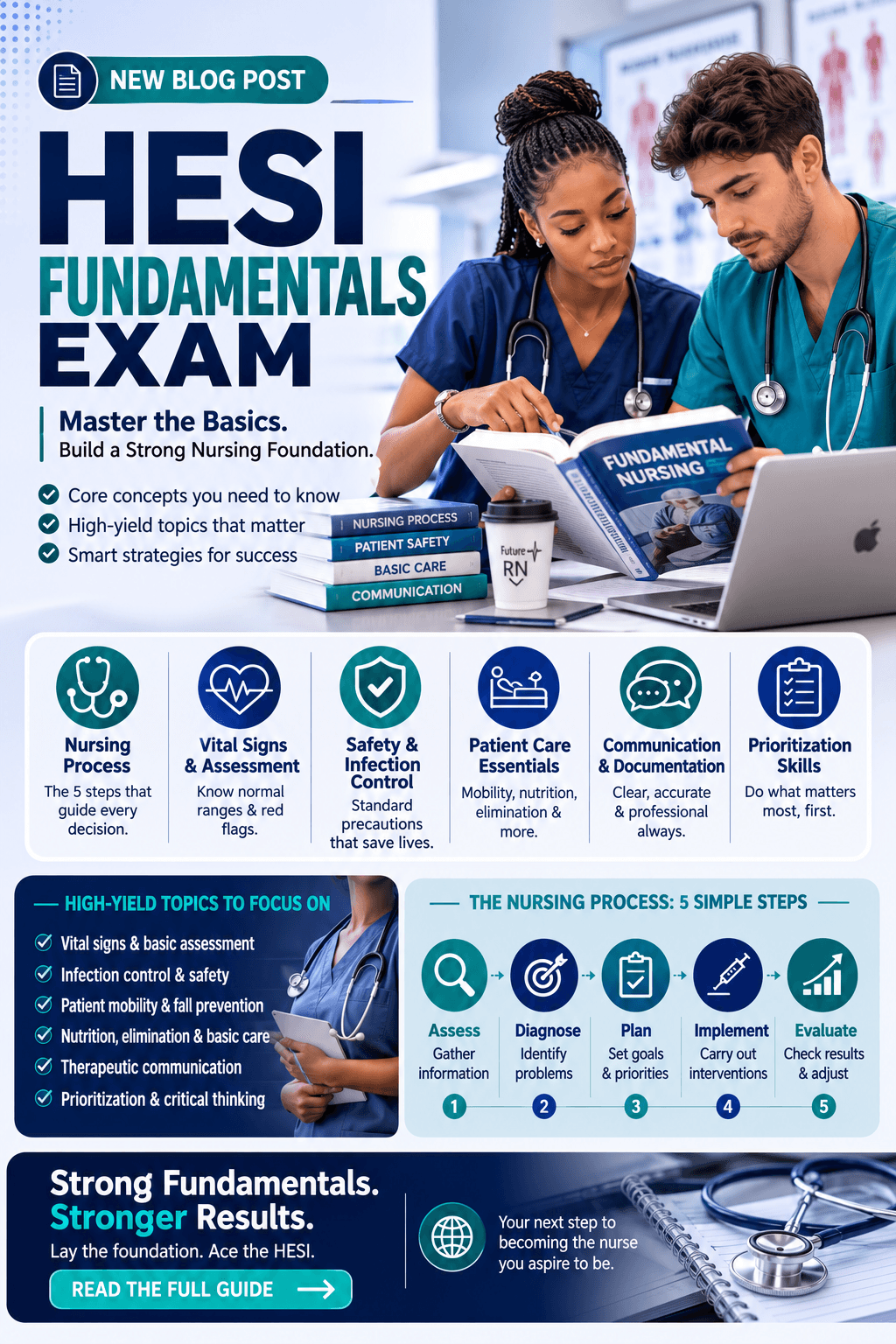
The HESI fundamentals questions typically address basic nursing process concepts and principles of basic patient care. The nursing process assessment diagnosis planning implementation and evaluation and the role each phase plays in guiding patient care decisions.
- Vital signs and basic assessment -- normal ranges and proper technique and recognition of significant deviations from expected findings.
- Infection control and safety – hand hygiene, standard precautions and basic principles for prevention of healthcare associated infections.
- Patient mobility and positioning Body mechanics, fall prevention, and positioning for different patient needs
- Basic concepts of nutrition and elimination – basic concepts that apply in almost every aspect of patient care.
- Communication and documentation — principles of effective communication with patients and clear, accurate nursing documentation.
Core Concept: Nursing Process
The nursing process is a central organizing framework that is tested throughout the fundamentals content.
- Assessment — gathering subjective and objective patient data to form the foundation for all subsequent care decisions.
- Diagnosis — identifying actual or potential patient problems from assessment findings.
- Planning – setting goals and prioritizing interventions based on identified patient needs.
- Implementation – The carrying out of planned nursing interventions.
- Evaluation – assessing the effectiveness of the interventions and changing the plan of care as needed.
Understanding how these 5 phases relate to each other, instead of just knowing them in isolation, allows you to apply this framework when you are faced with scenario-based questions across the exam.
High-Yield Topics to Review Again
For example, prioritization principles, such as knowing which patient needs require the immediate nursing attention in a given scenario.
- Basic infection control and standard precautions – these are principles that are always the same in nearly every clinical setting.
- Interpretation of vital signs – understanding what is normal and when findings require additional assessment or intervention.
- Patient safety fundamentals, including fall risk assessment and simple safety measures in various care settings.
- Principles of therapeutic communication as basic communication principles are also repeated throughout the mental health and other specialty content.
Types of Questions You’ll Encounter Most Common
- Priority questions ask which nursing action should be performed first when there are several reasonable actions.
- Questions that assess you based on a scenario. You are given patient data and asked to interpret this data and determine what you should do next.
- Safety and infection control questions Test knowledge of standard precautions and principles of safe practice.
- Documentation and communication questions that test knowledge of clear, professional nursing communication standards.
How to Study Fundamentals the Right Way
- Do not just memorize each phase of the nursing process in isolation. Study the nursing process as a connected framework.
- Practice prioritization questions specifically. This is a tested skill consistently and relates directly to real clinical decision making.
- Review standard precautions and safety principles regularly, as these are concepts that are broadly applicable to almost every patient situation.
- Relate fundamentals content to other specialty areas, including the resurgence of basic principles in medical-surgical, pediatric, and other content areas.
- Scenario based practice questions are helpful because fundamentals content is often tested in applied clinical situations rather than isolated facts.
Common Mistakes to Avoid
- Treating fundamentals" to warrant serious review, despite it playing a consistent, fundamental role throughout the entire exam.
- Learning the steps of the nursing process without understanding how to use them and how they relate to prioritization and decision making questions.
- Underestimating the frequently asked prioritization-type questions that require real clinical reasoning, not just recall.
- Overlooking infection control, safety review, even as these principles keep emerging across nearly every specialty area.
In conclusion
The fundamentals section of the HESI exam may look basic at first glance, but it is the core foundation that will help you understand almost all other parts of the exam. Focus on the nursing process, prioritization principles, and safety concepts. Practice scenario-based questions that reflect real clinical reasoning to build a strong foundation that will help you throughout your HESI preparation—not just this section. These core concepts will also be directly relevant to you throughout your entire nursing career, no matter which specialty you end up in.