What Are Questions That Require Recall?
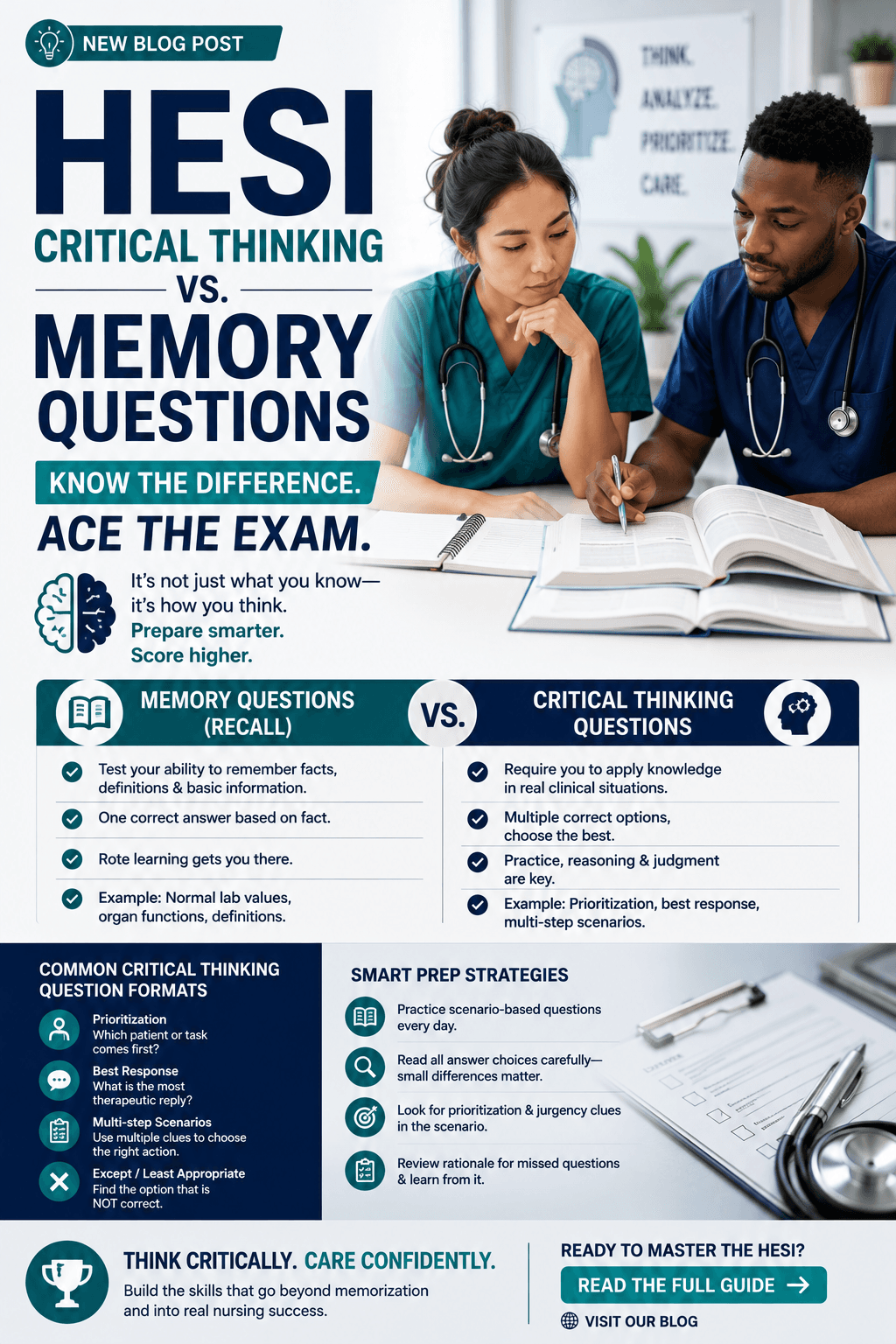
Recall questions test your ability to remember facts, definitions or basic information. The questions typically have one correct answer, based on memorization — such as knowing the normal range of a specific lab value or the function of a specific organ.
Recall questions are often more predictable because if you study the facts behind them, you can directly translate that into being able to answer them correctly.
What are questions for critical thinking?
Critical thinking questions, in contrast, require you to use knowledge in a specific clinical situation, and often ask you to weigh multiple pieces of information to decide on the best course of action. You are not simply recalling a fact; you are evaluating a situation, determining what information is most important and using your nursing judgment to make a decision.
Many of these questions provide you with a number of technically ‘correct’ pieces of information, and ask you to identify the most important in a particular context – a skill very different to simple memorization.
Differences between the Two Types of Questions
- Recall questions ask, “What is true?” Critical thinking questions ask, “What is most important in this specific situation?
- Recall questions usually have one correct answer based on fact. Critical thinking questions usually have multiple correct answers, but you need to pick the best or most suitable answer given the entire question.
- The common method used with recall questions is rote learning. Content knowledge alone is not enough; critical thinking questions can only be applied with practice, through scenario-based questions.
- Questions tend to feel more straightforward once content is learned. Critical thinking questions are hard even for good students, because critical thinking questions test reasoning, not just knowledge.
Common Formats for Critical Thinking Questions
Prioritization questions: Which patient or task should be addressed first, given several reasonable options?
- Best response questions, in which the user is asked what the best response is or what is most therapeutic (common in content about mental health and communication).
- Multi-step clinical scenario questions where you must combine multiple pieces of information about the patient before deciding on the correct nursing action.
- Except or Least Appropriate questions ask you to find the answer choice that is NOT correct. Be careful to read the question wording.
Why Critical Thinking Questions Are Harder to Answer
Many students say that critical thinking questions are more stressful than recall questions, even when they know the content well. This usually comes down to a few specific challenges. When there are several plausible answers, when more than one option might seem reasonable at first blush, you can create real uncertainty.
The time pressure makes this difficulty worse, as these questions often demand a more careful reading and reasoning process than simpler recall-based questions. Second-guessing is more likely, as the trick is often subtle differences in wording between similar answer choices.
How to Prepare Specifically for Critical Thinking Questions
- Do not spend a lot of time reviewing definitions or flash cards. Do many practice questions, especially ones that are scenario based?
- So read each answer choice carefully before making your selection. Many critical thinking questions are based on the difference between two answer choices that sound reasonable.
- Practice justifying your choices, not just picking an answer, because understanding why an answer is best helps reinforce the underlying judgment skill.
- Look for prioritization clues in the question, such as specific patient symptoms or urgency clues to the most appropriate action.
- Do not just check the correct answer for missed critical thinking questions. Review the rationale for why the correct answer was better than the one you selected.
- Answering critical thinking questions as if they were simple recall questions, looking for a textbook fact as opposed to all the facts of the situation presented
- Skimming over the scenario details, missing key contextual clues, which lead to the best answer.
- Being stuck between two plausible answers without a clear process of reasoning behind it, rather than practicing a consistent way of narrowing down choices.
- Assuming that strong content knowledge alone will be sufficient preparation and not realizing how much practice this skill takes.
Conclusion
Understanding the difference between rote recall questions and critical thinking questions will make a huge difference in your preparation for the HESI exam. Recall questions respond well to tried and true memorization techniques. Critical thinking questions require intentional practice using knowledge in realistic clinical situations. If you carve out dedicated study time to practice scenario-based practice, instead of assuming that strong content knowledge alone will carry you through, you will build the applied reasoning skills that these questions truly require, and that will serve you throughout your entire nursing career.