Why it matters: HESI Anatomy and Physiology
Anatomy and Physiology the HESI exam includes questions on anatomy and physiology because a good understanding of how the body works is the basis for almost everything you will learn in nursing school. The concepts discussed in this section are encountered frequently in pharmacology, medical-surgical nursing, and patient assessment courses; therefore, early mastery is particularly beneficial.
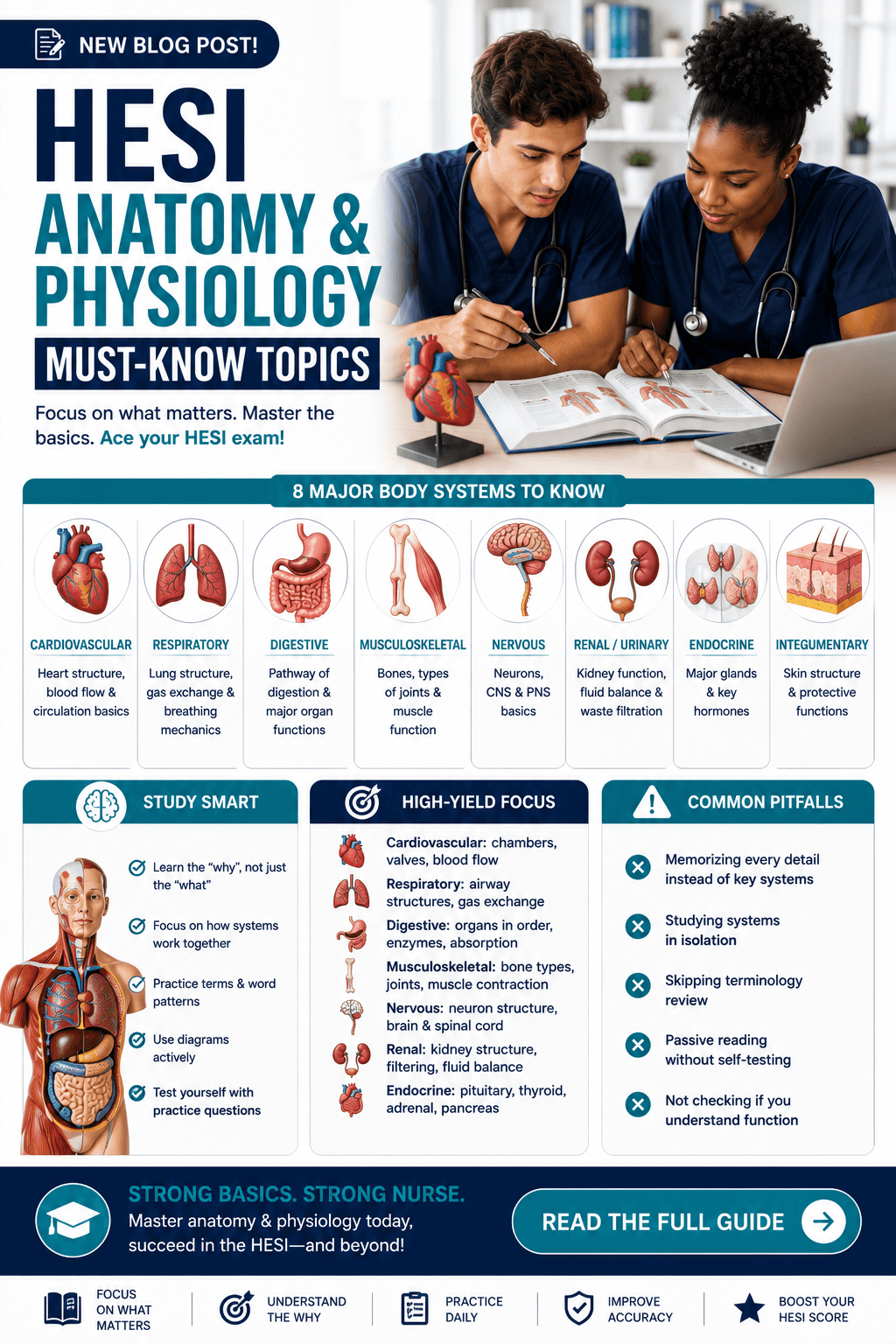
Major Body Systems to Study
The following systems are the main source of content for the HESI exam in relation to anatomy and physiology:
- Cardiovascular system: Heart structure and blood flow routes; basic ideas of circulation
- Respiratory system — structure of lungs, gas exchange, mechanics of breathing.
- Digestive system-digestion pathway from mouth to intestines and major organ functions.
- Musculoskeletal system – the basics of bone structure, types of joints and muscle function.
- Nervous system — basics of neuron function, central and peripheral nervous systems.
- Renal / urinary system – kidney function, fluid balance and filtering of waste.
- Endocrine system – Major glands and their hormones.
- Integumentary system – skin structure and its functions in protection and regulation
Basic Concepts in Each of the Systems
The HESI exam often tests functional understanding, not just memorizing structures. You need to know how each system works, not just what it has made of. Learn the “why” not just the “what” What is less important is that the heart has four chambers. We know the sequence of blood flow through them. Concentrate on system interactions. Many questions consider how the systems work together, such as how the respiratory and cardiovascular systems work together during gas exchange. Discover common terminology patterns. The exam uses prefixes and suffixes like “cardio-,” “-itis,” and “-ology” repeatedly. If you know these, you can figure out new words.
High-yield topics in each major system
- Cardiovascular: Heart chambers and valves, blood flow through the heart, basic blood pressure concepts.
- Respiratory: Structures of the upper and lower respiratory tract; basic process of oxygen and carbon dioxide exchange
- Digestive: the organs of digestion in sequence, the basic role of enzymes and absorption
- Musculoskeletal: major classifications of bones, types of joints, and basic concepts of muscle contraction.
- Nervous: Central and peripheral nervous systems, basic structure and function of a neuron.
- Renal/urinary: the basic structure of the kidney and its function in filtering blood and regulating fluid balance.
- Endocrine: major glands and main hormones Pituitary Thyroid Adrenal Pancreas
How to Study Anatomy & Physiology Effectively
- Use diagrams actively (label the structures yourself, rather than passively looking at pre-labeled images).
- Cluster ideas together, learn about entire systems in context instead of simply memorizing facts.
- Test yourself with quiz-style questions. The HESI exam is testing application and recognition, not just pure recall.
- Relate structure to function. Ask yourself “why does this matter?” about each structure, you examine.
- Review terminology patterns often; recognizing prefixes and suffixes can help you work through unfamiliar terms on exam day.
Common Errors to Avoid
- Memorizing every little structure instead of the big frequently tested systems.
- Looking at systems in isolation missing important connections between how different systems interact.
- Skipping terminology review, which makes unfamiliar questions, look more difficult than they are.
- Just passively reviewing rather than testing yourself with practice questions along the way.
Summary
Anatomy and physiology can feel a bit overwhelming because there is so much material that could technically be covered, but HESI tends to focus on foundational concepts that are high yield and not obscure details. By focusing on the major body systems, learning both function and structure, and using active recall techniques, you will be able to tackle this section with focus and confidence, instead of trying to memorize an entire anatomy textbook. Good mastery of these basics will also help you well beyond the HESI exam, because this knowledge is the backbone of your completely nursing education.