HESI A2 Reading: Main Idea and Inference Strategies
Reading comprehension is more than recognizing words on a page. Students preparing for the HESI A2 need to understand what a passage is communicating, identify important details, and draw conclusions supported by the text. Two useful skills to practice are identifying the main idea and making inferences. These skills can help you approach passages more systematically instead of guessing based on a single sentence.
What Is the Main Idea?
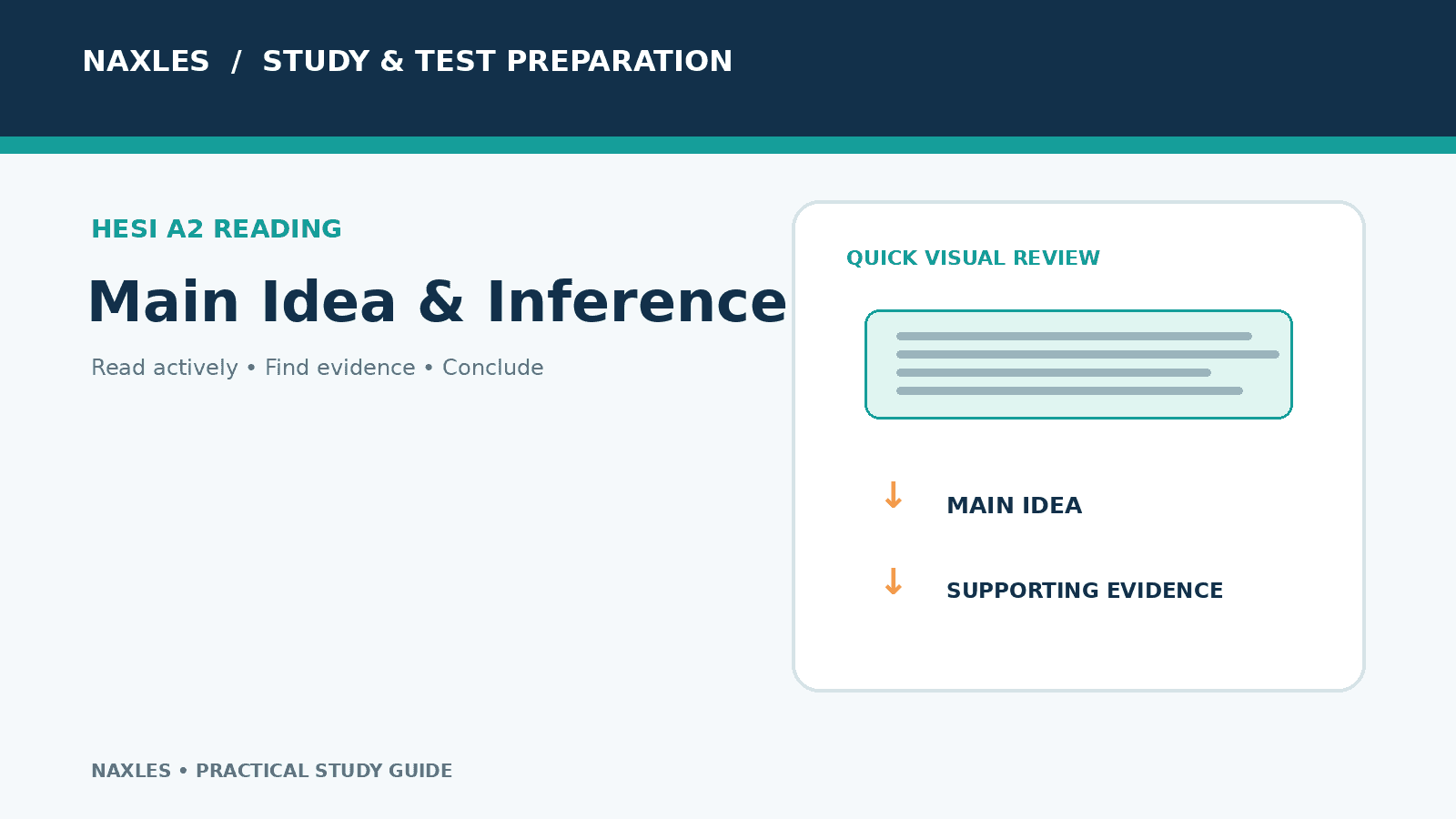
The main idea is the central point a passage communicates. It is what the author most wants the reader to understand. Consider this short passage: Regular physical activity can support general health. Walking, cycling, and swimming are examples of activities that can help people stay active. Choosing an activity that fits a person's schedule may make it easier to maintain a routine. The main idea is that regular physical activity supports health and that choosing a suitable activity can help people stay consistent. The examples of walking, cycling, and swimming are supporting details. They help explain the passage but are not its central message.
How to Find the Main Idea
Start by reading the entire passage. Avoid choosing an answer simply because it repeats a phrase from the first sentence. Then ask yourself: What is the passage mainly about? What point connects the supporting details? If I had to summarize the passage in one sentence, what would I say? A good main-idea answer should cover the passage as a whole. An answer that focuses on only one small detail may be too narrow.
What Is an Inference?
An inference is a conclusion drawn from information in the passage. It is not always stated directly, but it must be supported by evidence. For example: Jordan checked the weather forecast, placed an umbrella in his bag, and left home wearing a raincoat. The passage does not directly say that Jordan expects rain. However, it is reasonable to infer that he thinks rain is possible. An inference should be based on clues in the text, not on personal assumptions or outside information.
How to Make Strong Inferences
Look for details that suggest an unstated idea. Consider what those details mean together. If a passage describes a student studying late, reviewing notes, and completing practice questions, you might infer that the student is preparing for an exam. You should not infer that the student will definitely pass, because the passage does not provide enough evidence for that conclusion. When evaluating answer choices, eliminate options that introduce information not supported by the passage.
Main Idea vs. Supporting Detail
A main idea summarizes the central message. A supporting detail explains, illustrates, or provides evidence for that message. For example, if a passage discusses the importance of sleep for learning, a detail about memory consolidation may support the main idea. It is not necessarily the main idea by itself.
A Simple Practice Method
After reading a passage, write a one-sentence summary. Then list two or three details that support it. Finally, identify one reasonable inference and point to the words that support it. This exercise helps you separate what the passage directly states from what you can reasonably conclude.
Final Thoughts
Main-idea and inference questions become more manageable when you slow down and look for evidence. Read the entire passage, distinguish central points from examples, and avoid choosing answers that go beyond what the text supports.