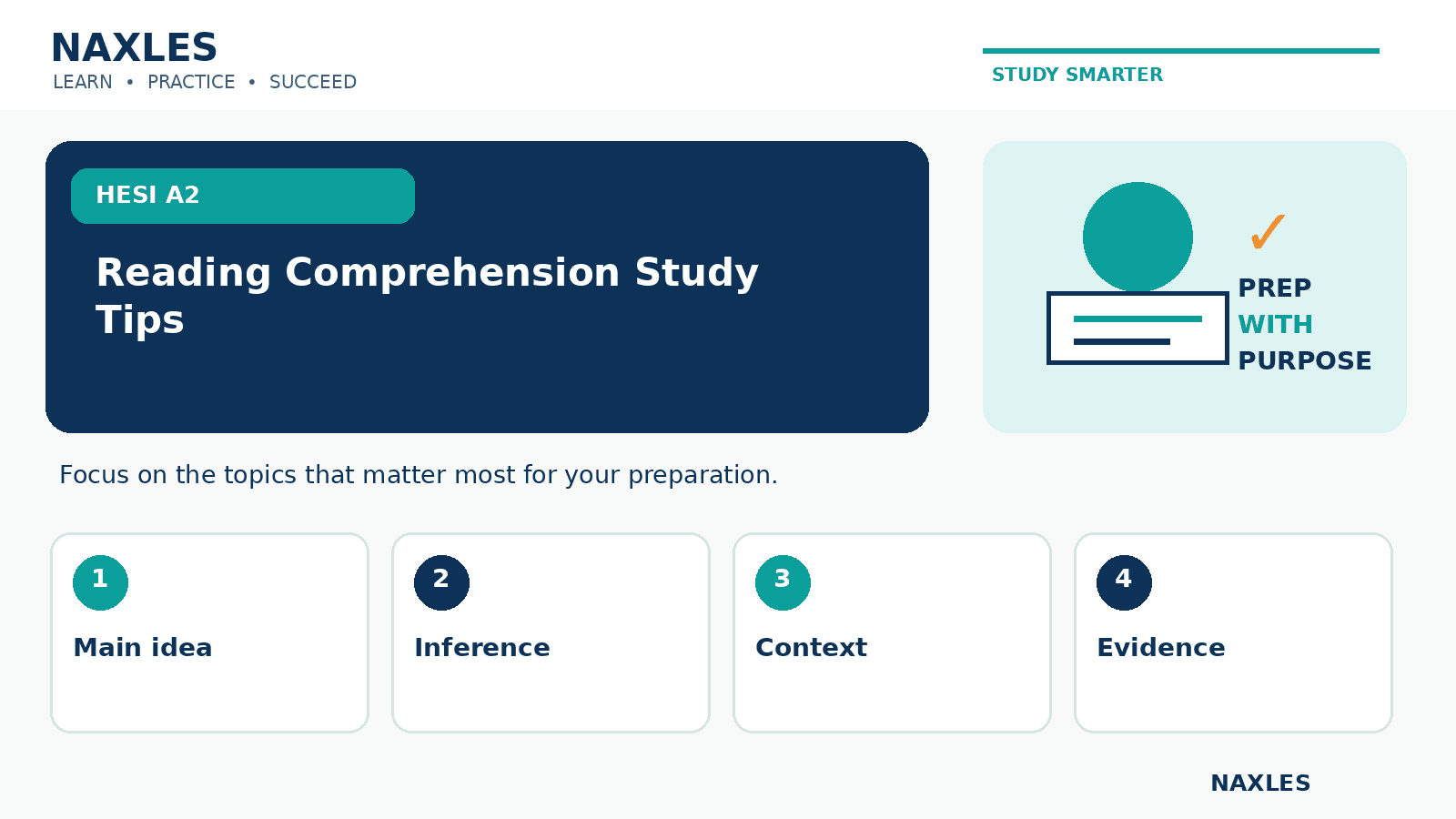
HESI A2 Reading Comprehension Study Tips
Reading comprehension is not simply about reading a passage quickly. You need to understand what the passage says, identify important information, and draw reasonable conclusions. A focused practice routine can help you become more comfortable with these skills.
Practice Finding the Main Idea
After reading a passage, ask yourself: What is this passage mainly about? Try to summarize the passage in one sentence. If your summary includes a small detail rather than the overall message, go back and look at the passage again.
Look for Supporting Details
The main idea is supported by specific information in the passage. Practice identifying:
- Examples
- Facts
- Explanations
- Reasons
- Evidence
This can help you distinguish the central idea from information that only supports it.
Practice Vocabulary in Context
You may encounter unfamiliar words. Instead of immediately trying to memorize every unfamiliar word, use the surrounding sentence to determine what the word probably means. Look at the words before and after it and consider how the sentence would change if the word had a different meaning.
Work on Inferences
Some questions require you to reach a conclusion based on information in the passage. An inference should be supported by the text. Avoid choosing an answer simply because it sounds reasonable in real life. Ask: What evidence in the passage supports this answer?
Read Actively
While practicing, pay attention to:
- The purpose of the passage
- The main idea
- Important details
- Relationships between ideas
- The meaning of unfamiliar words
- Conclusions supported by the text
Review Your Mistakes
Don't simply record whether an answer was right or wrong. Write down why you selected the wrong answer. Over time, you may notice patterns in the types of questions you struggle with.
Final Thoughts
Strong HESI A2 Reading preparation comes from repeated practice with passages and questions. Focus on understanding the main idea, identifying supporting details, interpreting vocabulary in context, and making evidence-based inferences.