Why a Targeted Formula List Matters
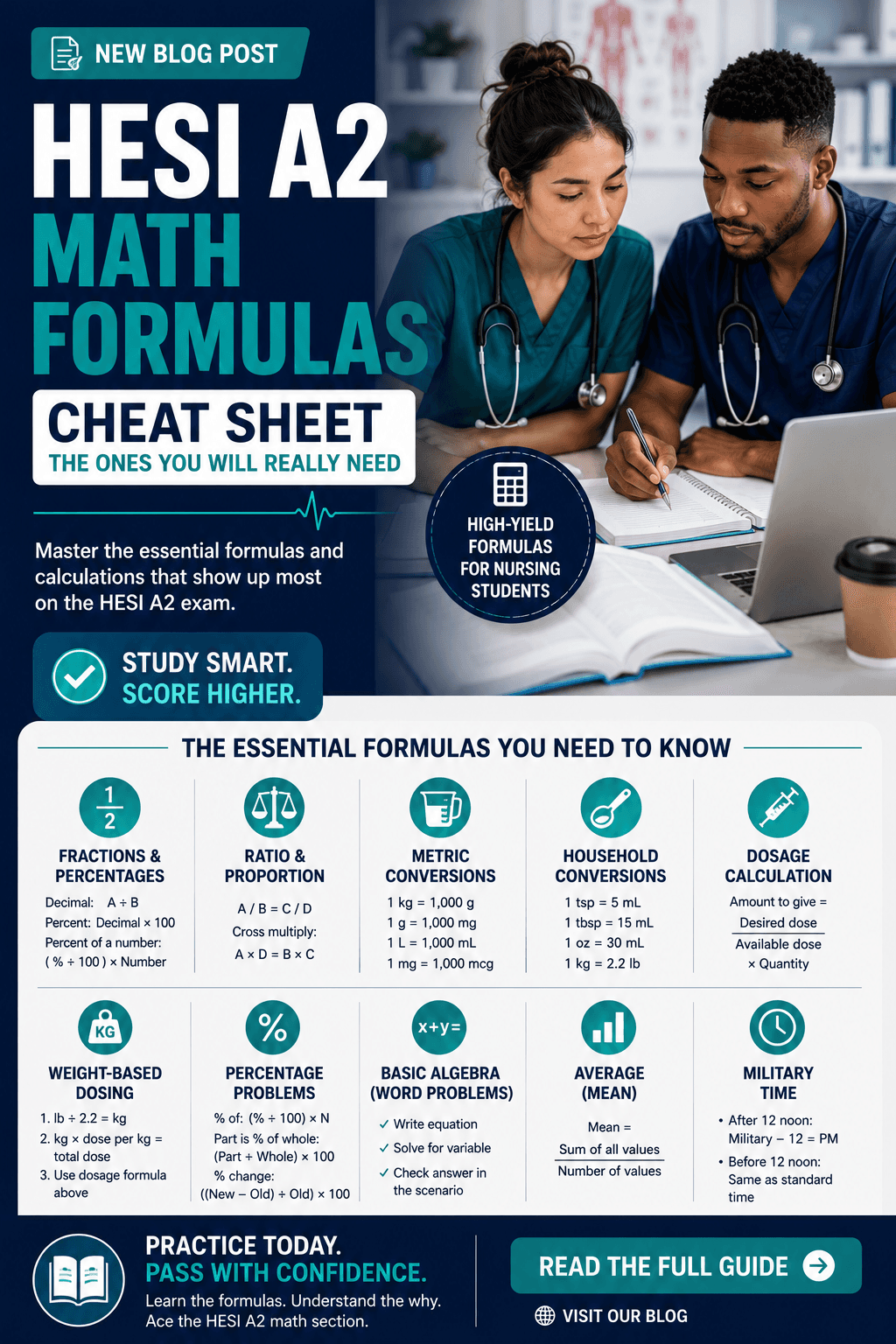
The HESI A2 math section is not examining a broad, open-ended mathematical knowledge but a rather specific, predictable set of skills. Therefore, it is usually more helpful to learn a few major formulas and calculation methods than to try to remember the entire math you have ever learned. This cheat sheet is about those high-yield formulas.
Simple math and fractions
These are not really formulas, but there are a few basic conversion relationships you should know by heart because they show up repeatedly in bigger word problems.
Converting a fraction to a decimal:
- Divide the numerator by the denominator.
- Decimal to Percent: Multiply by 100.
- Divide by 100 to convert a percentage to a decimal.
- How to find a percentage of a number: (percentage ÷ 100) × number
Ratio & Proportion
Ratio and proportion problems are the focus of many HESI A2 math questions, particularly those modeled after dosage calculations.
- Basic proportion setup: A / B = C / D.
- You solve for the unknown value by cross-multiplying: A * D = B * C.
- Example application 2 tablets treat 500 mg dose 750 mg dose. What about? Cross multiply 2/500 = X/750 to get X.
Conversions metrics
Questions about unit conversion are common. They may be asked as a separate question or as part of a larger word problem.
- 1 kg = 1,000 g (grams)
- 1 gram (g) = 1,000 milligrams (mg)
- 1 liter (L) = 1000 milliliters (mL)
- 1 mg = 1,000 mcg
If you memorize these core relationships, you’ll be able to zip between units without having to derive them mid-question.
Metric and Household Conversions
Some HESI A2s have conversions between household and metric measurements. These are also something to have on hand.
- 1 teaspoon (tsp) = 5 mL
- 1 tbsp. = 15ml
- 1 ounce = 30 milliliters
- 1 kg = 2.2 lb. (pound)
Basic Dosage Calculation Equation
- Dosage style questions are one of the most tested applied math problems on the HESI A2.
- Amount to administer = Desired dose / Available dose x Quantity
- A patient requires 500 mg of a medication. Concentration available: 250 mg per 5 mL By the formula: (500 ÷ 250) × 5 = 10 mL.
Weight Based Dose Formula
Some questions require the patient’s weight to be factored in for the dosage calculation, which is an additional conversion.
- Step 1: If weight is in pounds convert to kilograms using the conversion of 2.2 lb. = 1 kg.
- Step 2: Multiply the patient’s weight in kilograms by the prescribed dose per kilogram to determine the total dose required.
- Step 3: Use the basic dosage calculation formula above to find the amount to be given at the end.
Word Problems Involving Percentages
Percentage problems are often embedded within a word problem rather than being a standalone formula question.
- To determine what percent one number is of another. (Part ÷ Whole) x 100
- Part ÷ (Percentage / 100) = Whole.
- Percentage increase or decrease is calculated by ((New Value – Original Value) / Original Value) x 100.
Basic Algebra in Word Problems
- Some HESI A2 questions will require you to set up and solve a simple algebraic equation from a word problem.
- First, write the word problem as an equation, defining the unknown variable before you begin to solve.
- Use standard algebraic steps to isolate the variable. Combine like terms, divide, or multiply to solve for the unknown.
- Check your answer by plugging it back into the original word problem, confirming that it makes logical sense within the scenario described.
Average (Mean)
You will see basic averages from time to time. Especially in word problems with multiple pieces of data. Mean formula: Sum of all values / number of values.
Converting to Military Time
Some versions of the HESI A2 have basic military time conversion, which is worth a quick review even though it is not a traditional formula. If the time is after 12 noon subtract 12 from the military time to get the standard time (e.g. 1400 is 2:00 PM). Military time is generally the same as standard time for hours before noon, no conversion needed.
How to Get the Most Out of This Cheat Sheet
Knowing the formulas is only half the battle. You must practice using each formula on a few different sample problems. Knowing the formula is important, but knowing when to use a particular formula is as important. Do not just read this list. Write out the formulas by hand, repeatedly. This will enforce memorization thru active recall.
Time yourself with these formulas under practice conditions, since both speed and accuracy matter on the actual exam. Keep this list handy during your final review days, using it as a quick-reference tool, rather than a substitute for the real practice and understanding.
Common Pitfalls to Avoid
- Reversing the numerator and denominator in ratio and proportion problems, resulting in upside-down, wrong answers.
- Not converting units before doing the calculations and getting values inconsistent in a single problem.
- Just learning the formulas and not practicing enough word problems to see what formula fits what situation.
Final Thoughts
Instead of reviewing all of general math knowledge ahead of your HESI A2 exam, studying this focused, high-yield list of formulas helps you study effectively and confidently. Pair this cheat sheet with regular practice, applying each formula to real word problems, and you will build the memorization and the applied reasoning skills you will need to move thru the math section quickly and accurately on exam day.