HESI A2 Math: Understanding Conversions and Measurement
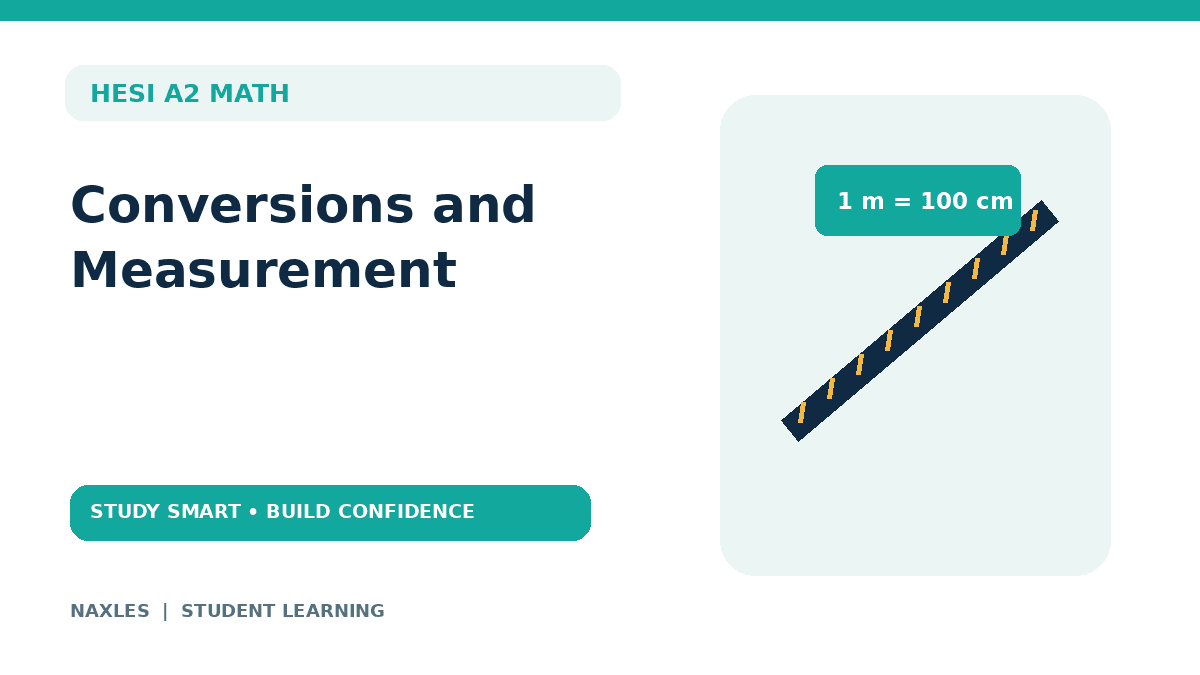
Measurement and unit conversions are useful skills to review when preparing for the HESI A2 Math section. These concepts appear in everyday situations, including cooking, measuring distances, and calculating quantities. A conversion changes a measurement from one unit to another without changing the actual quantity. For example, one meter and 100 centimeters represent the same length. Learning common conversion relationships and practicing how to use them can make measurement questions easier to solve.
1. Understand the Units First
Before performing a conversion, identify the unit you are starting with and the unit you need. Common measurement categories include: Length, such as meters, centimeters, and inches Weight or mass, such as grams, kilograms, and pounds Volume, such as liters, milliliters, and cups Time, such as seconds, minutes, and hours Read the question carefully because it may ask for a specific unit.
2. Convert Within the Metric System
The metric system uses units related by powers of ten, which makes many conversions straightforward. For example: 1 meter=100 centimeters To convert 3 meters into centimeters, multiply by 100: 3×100=300 Therefore, 3 meters equals 300 centimeters. To convert 450 centimeters into meters, divide by 100: 450÷100=4.5 Therefore, 450 centimeters equals 4.5 meters. The key is to understand whether the conversion requires multiplication or division.
3. Convert Between Liters and Milliliters
A liter contains 1,000 milliliters. To convert 2.5 liters into milliliters: 2.5×1000=2500 So, 2.5 liters equals 2,500 milliliters. To convert 750 milliliters into liters: 750÷1000=0.75 So, 750 milliliters equals 0.75 liters.
4. Convert Time Measurements
Time conversions are also useful to practice. Remember: 1 minute = 60 seconds 1 hour = 60 minutes 1 day = 24 hours For example, how many minutes are in 3 hours? 3×60=180 There are 180 minutes in 3 hours. If a question asks you to convert 150 minutes into hours and minutes, divide 150 by 60. That gives 2 hours with 30 minutes remaining.
5. Use Conversion Factors Carefully
A conversion factor is a ratio that represents two equivalent measurements. For example: 1 m 100 cm This ratio can be used to convert meters into centimeters. The units help you determine whether the calculation is set up correctly. When solving a question, write the units alongside the numbers. This can help you notice if you have multiplied or divided in the wrong direction.
6. Estimate Before Checking Your Answer
Estimation can help you catch mistakes. If you convert 2 meters into centimeters, you should expect a larger number because centimeters are smaller units. An answer of 0.02 centimeters would not make sense. Similarly, converting 500 milliliters into liters should produce a number smaller than 1 because 1,000 milliliters make a liter.
How to Practice Conversions
Create a list of common conversion relationships and practice using them in both directions. Begin with simple conversions before moving to word problems involving multiple steps. When you get a question wrong, check whether you misunderstood the units or used the wrong operation.
Final Thoughts
Measurement questions become easier when you understand the relationship between units. Practice writing down the starting unit, the target unit, and the conversion factor before calculating. This simple habit can help you avoid common errors.