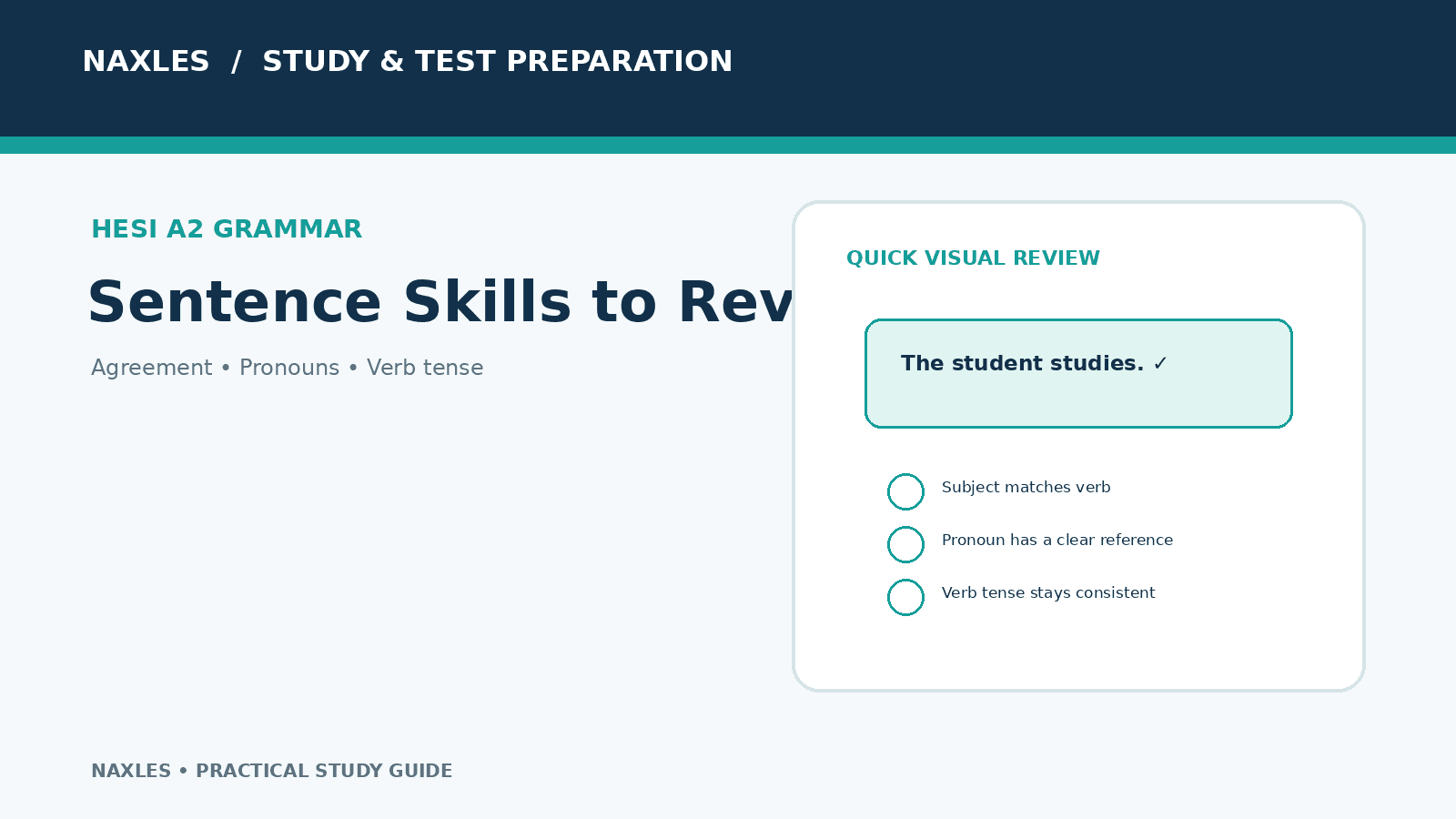
HESI A2 Grammar: Sentence Skills Every Student Should Review
Grammar questions can be challenging when a sentence looks familiar but contains a small error. Preparing for the HESI A2 Grammar section involves understanding how sentences are formed and recognizing common mistakes. Rather than memorizing isolated examples, focus on the rules that help you identify whether a sentence is complete, clear, and grammatically correct.
1. Subject-Verb Agreement
A verb should agree with its subject in number. For example: The student studies every evening. The students study every evening. The first sentence has a singular subject, student, and a singular verb, studies. The second has a plural subject, students, and the plural-form verb, study. Be careful when extra words appear between the subject and the verb. The list of assignments is on the desk. The subject is list, not assignments, so the singular verb is is correct.
2. Sentence Fragments
A sentence fragment is an incomplete sentence presented as though it were a complete one. For example: Because the student missed the lecture. This is a dependent clause. It leaves the reader waiting for the rest of the thought. A complete version could be: Because the student missed the lecture, she reviewed the notes afterward. When checking a sentence, look for a subject and a verb, and make sure the sentence expresses a complete thought.
3. Run-On Sentences
A run-on sentence occurs when two or more independent clauses are joined incorrectly. Incorrect: The exam was difficult I reviewed every question. Correct: The exam was difficult, but I reviewed every question. Another correct option is: The exam was difficult. I reviewed every question. You can also use a semicolon when the two independent clauses are closely related: The exam was difficult; I reviewed every question.
4. Pronoun Agreement
A pronoun should clearly refer to the noun it replaces and should agree with that noun. For example: The instructor explained the assignment, and she answered questions. The pronoun she refers to the instructor. When a sentence contains several nouns, check whether the pronoun's reference is clear. Ambiguous pronouns can make a sentence confusing even if the grammar appears correct.
5. Verb Tense Consistency
Verb tense indicates when an action takes place. A sentence should generally maintain a consistent tense unless the meaning requires a change. Incorrect: The student reviewed the chapter and answers the questions. Correct: The student reviewed the chapter and answered the questions. Both verbs describe completed actions, so the past tense is appropriate.
How to Practice Grammar Questions
Read each sentence slowly and identify its subject and main verb. Check whether they agree, whether the sentence is complete, and whether the verb tense makes sense. When you answer a practice question incorrectly, write down the grammar rule involved. Over time, this creates a focused review list of the mistakes you tend to make.
Final Thoughts
Grammar preparation is easier when you understand the structure behind a sentence. Practice identifying subjects, verbs, complete thoughts, and unclear pronouns. These skills can help you recognize errors more reliably during the HESI A2.


