Why Clear Explanations Beat the Rest
Grammar textbooks often take simple ideas and make them seem harder than they really are by giving them technical names. With the HESI A2, the task is not to identify grammatical terms but to recognize what sounds and reads correctly. Try to get the logic behind the formal definitions. It is more effective than just memorizing.
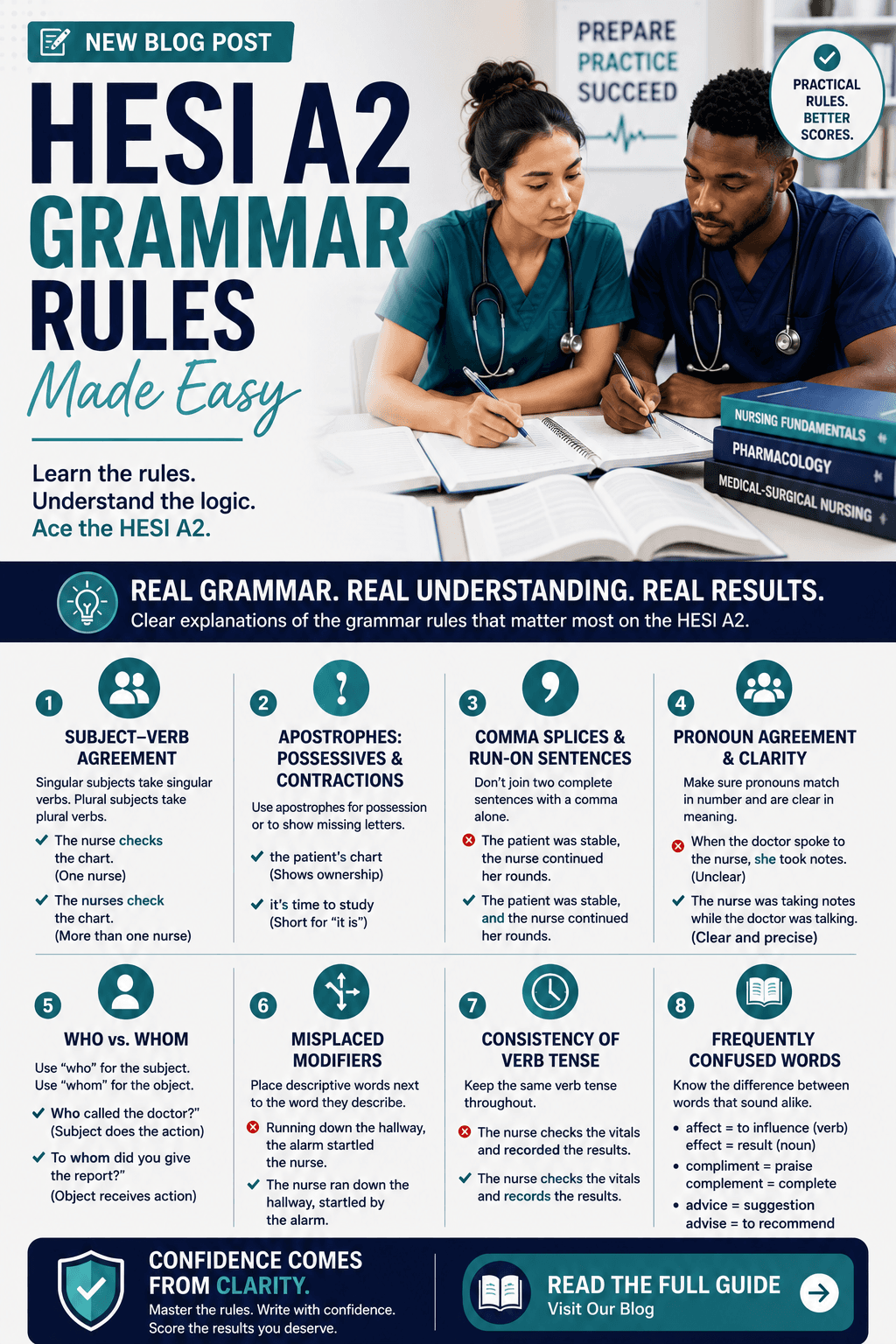
Subject–verb agreement
The rule, in plain English: singular subjects require singular verbs, and plural subjects require plural verbs.
- Simple example: "The nurse checks the chart" (one nurse, singular verb) and "The nurses check the chart" (more than one nurse, plural verb).
- Where it gets tricky: It is easy to accidentally match the verb with the wrong word when extra descriptive words sit between the subject and verb. In "The list of patients is ready”, the subject is "list" (singular) and not "patients" so the verb "is" stays singular even when "patients" is sitting right next to it.
- Quick check: Try taking out any of the descriptive phrases between the subject and verb and see if they still sound right together by themselves.
Apostrophes: Possessives and Contractions
The rule, in plain English, is that apostrophes are for showing ownership or replacing omitted letters in a word, not just for making a word plural.
- Possessive example: “the patient’s chart” means the chart belongs to the patient.
- Contraction example: "it's" is a shorter version of "it is."
- The most common confusion is between its (which indicates possession, e.g. “the dog wagged its tail”) and it’s (short for “it is”). The simple trick: If you can substitute the word with “it is” and the sentence still makes sense, use “it’s.” Otherwise, use "its."
Comma Splices and Run-On Sentences
The rule, in simple English: you cannot just stick two complete sentences together with a comma alone, you need a stronger link.
- The problem: “The patient was stable, the nurse continued her rounds” This is two complete sentences joined awkwardly with a comma.
- The fix: Separate them with a period, join them with a semicolon, or add a connecting word such as “and” or “so” after the comma.
- Simple test: if you can replace the comma with a period and still have two full, independent sentences, then a comma by itself usually is not enough to join them.
Subject-Verb Agreement
The rule, in plain English: pronouns have to agree with whatever they refer back to, in number and clarity.
- Example for number matching: "Every nurse should bring her own stethoscope" vs "All nurses should bring their own stethoscopes" - the pronoun has to match whether you are referring to one or several persons.
- Clarity problem example: When the doctor spoke to the nurse, she took notes — it is not clear whether “she” refers to the doctor or to the nurse. If you write it for clarity, such as "The nurse was taking notes while the doctor was talking," the confusion goes away.
Who vs whom
The rule, in simple English: If the pronoun is doing the action, use “who.” If the pronoun is receiving the action, use “whom.”
Simple trick: try switching in “he” or “him” for “she” or “her.” If he fits, use whom. If he fits, use whom. For example, "Who called the doctor?" works because you would say, "He called the doctor, and “not” He called the doctor."
Misplaced Modifiers
- In plain English: descriptive words or phrases must be immediately adjacent to what they describe or the sentence may happen to say something funny.
- The problem example: “Running down the hallway, the alarm startled the nurse” — as written, this technically means the alarm was running down the hallway, not the nurse.
- The fix: "The nurse ran down the hallway, startled by the alarm" — now we know who was really running.
Consistency of Verb Tense
- The rule in plain English is this: use one period throughout a sentence or passage unless there is a good reason to change.
- The problem example: “The nurse checks the patient’s vitals and recorded the results” blends present tense (“checks”) with past tense (“recorded”) arbitrarily.
- The fix: Choose one tense and stick with it. For example: “The nurse checks the patient’s vitals and records the results.” Alternatively, “The nurse checked the patient’s vitals and recorded the results.”
Frequently Confused Words
Some pairs of words are repeated because they sound alike or look alike but have different meanings.
- Affect vs. effect: “Affect” is usually an action (verb) and “effect” is usually a result (noun). The drug alters blood pressure, and that alteration is the effect.
- Than vs. then. “Than” is used to compare two things (“faster than " ).” Then " refers to time or sequence (“first this, then that " ).
- Your vs. you’re: “Your” is possessive (“your chart”), “you’re” is short for “you are.”
How to Practice These Rules Efficiently
- Work on real sentence-correction questions, not just definitions, since applying these rules is more important than memorizing labels.
- Practice reading your answer choices aloud, because often-incorrect grammar “sounds wrong” before you can explain exactly why.
- Keep a running list of your personal repeat mistakes, review it, and keep reviewing it until those specific patterns stop tripping you up.
Final Thoughts
The HESI A2 is not about memorizing formal linguistic terminology—it is about recognizing what sounds and reads correctly based on a handful of consistent, learnable patterns. If you understand these rules in plain, practical language – not technical jargon – you will feel much more confident in the grammar section and can use what you already know intuitively about how English actually works.