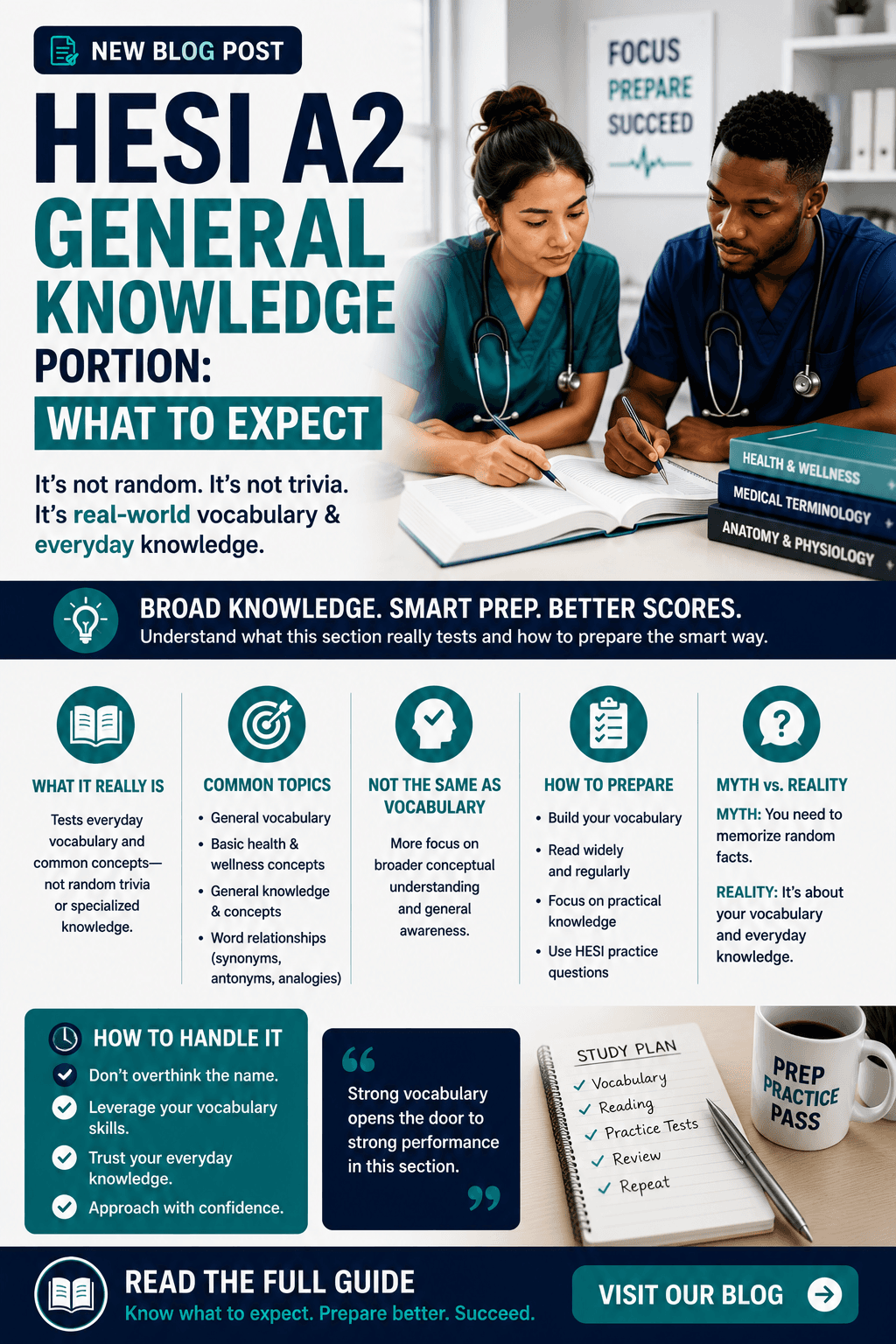
What “General Knowledge” Actually Is on the HESI A2?
The broad-sounding name does not mean the general knowledge section is testing anything random or open-ended, like world knowledge. In practice, this often overlaps quite a bit with the vocabulary section, in that it is testing your knowledge of common words and basic general concepts as opposed to specialized or obscure information. This only adds to the confusion about what it actually covers. Some versions of the exam have general knowledge mixed directly in with the vocabulary section, rather than being listed as a completely separate category.
Why the Section Is Confusing at First
- There are several reasons why students generally feel unsure about this particular section.
- The name is non-specific and vague. Compare with the section “chemistry” or “anatomy “. That tells you exactly what you are going to get.
- Some programs test this content as a separate section and others combine it with vocabulary. The HESI A2 has different versions that handle this content differently.
- Unlike more distinct academic fields, there is no widely standardized study guide specifically entitled "general knowledge."
What Subjects Usually Appear
- The material will be drawn from general, everyday vocabulary and basic conceptual understanding, not from academic specialties.
- General vocabulary – words used in everyday speech, that exceed the basic vocabulary of the elementary level, but do not require specialized medical or scientific vocabulary.
- General knowledge of basic health and wellness concepts – common health topics that a reasonably informed adult would be expected to know, without nursing-specific training.
- General knowledge and concepts – the kind of general knowledge acquired from everyday reading, education and life experience, not obscure trivia.
- Relationships and reasoning of words, such as finding synonyms, antonyms or analogies using general vocabulary knowledge.
What This Section Is Not: Vocabulary
There is so much overlap between the content of general knowledge and vocabulary that it is worth understanding the subtle distinction where it exists. Vocabulary questions are typically word-focused, asking for the definition of a word and how it is used in a sentence.
(Where distinguished separately, general knowledge questions might be a bit more focused on broader conceptual understanding/general awareness rather than just testing a single word definition.)In practice, many students find these two sections blends, because strong vocabulary knowledge also directly helps when performing on general knowledge questions.
How to Prepare Well For This Section
- The topic is broad and somewhat vague and takes a different approach than more well defined academic topics in preparing for this section.
- Start with improving your general vocabulary. This will be the basis for both the vocabulary and the general knowledge sections at the same time.
- Read widely and regularly in the weeks before your exam. Regular exposure to different vocabulary and general ideas by reading generally builds the kind of broad knowledge that this section rewards.
- Don't try to learn a long list of 'general knowledge' facts, as this section is not designed to test obscure trivia, but rather the sort of practical knowledge and vocabulary an informed adult would normally have.
- Practice with HESI-specific sample questions. Seeing actual example questions will clarify the scope of the section much better than trying to guess based on the title alone.
Frequently Asked Questions about This Section
- Myth: You have to memorize random trivia on every possible subject area. Reality: The section is usually derived from practical vocabulary or ordinary knowledge, not arcane or esoteric trivia.
- Misconception: You need to be a nurse to understand this section. Reality: This portion of the HESI A2, like much of the rest of the exam, is not about nursing-specific knowledge, but about overall academic readiness—that comes later in your education.
- Myth: A “general knowledge” study guide applies across the board. The reality is that this content is very vocabulary-heavy, so having a strong general vocabulary will cover most of what this section is actually testing.
How long should you spend on this section?
- Since it overlaps with vocabulary, it usually does not need a very separate, dedicated study block outside of your vocabulary review.
- Combine your general knowledge and vocabulary study. They are more closely related than separate subjects with different books to study are.
- It is better to have regular, ongoing study of general knowledge than to do a lot of intensive, isolated study marked “general knowledge.”
- Some schools may not even include this section, depending on which HESI A2 sections they require, so check with your individual program to see if this section is tested separately.
Concluding Thoughts
The nebulous label “general knowledge” of the test often causes more anxiety than the content actually warrants, as it mostly consists of vocabulary and general, practical knowledge, rather than obscure or specialized trivia. By working on solid general vocabulary skills and keeping yourself generally interested in a variety of reading material, you will find that this section is much more manageable than the vague title might lead you to believe. You will need to check with your particular nursing program to see exactly how this content is tested on your version of the exam and think of it as an extension of your vocabulary study rather than a completely separate, mysterious topic.