The importance of vocabulary-focused review in biology
The HESI A2 biology is very much based on whether you understand the words correctly or not. Many questions are based on identifying or understanding a word correctly in a context. In addition, by reviewing terms, rather than only larger concepts, you can sharpen your recall in a concrete way right before your exam.
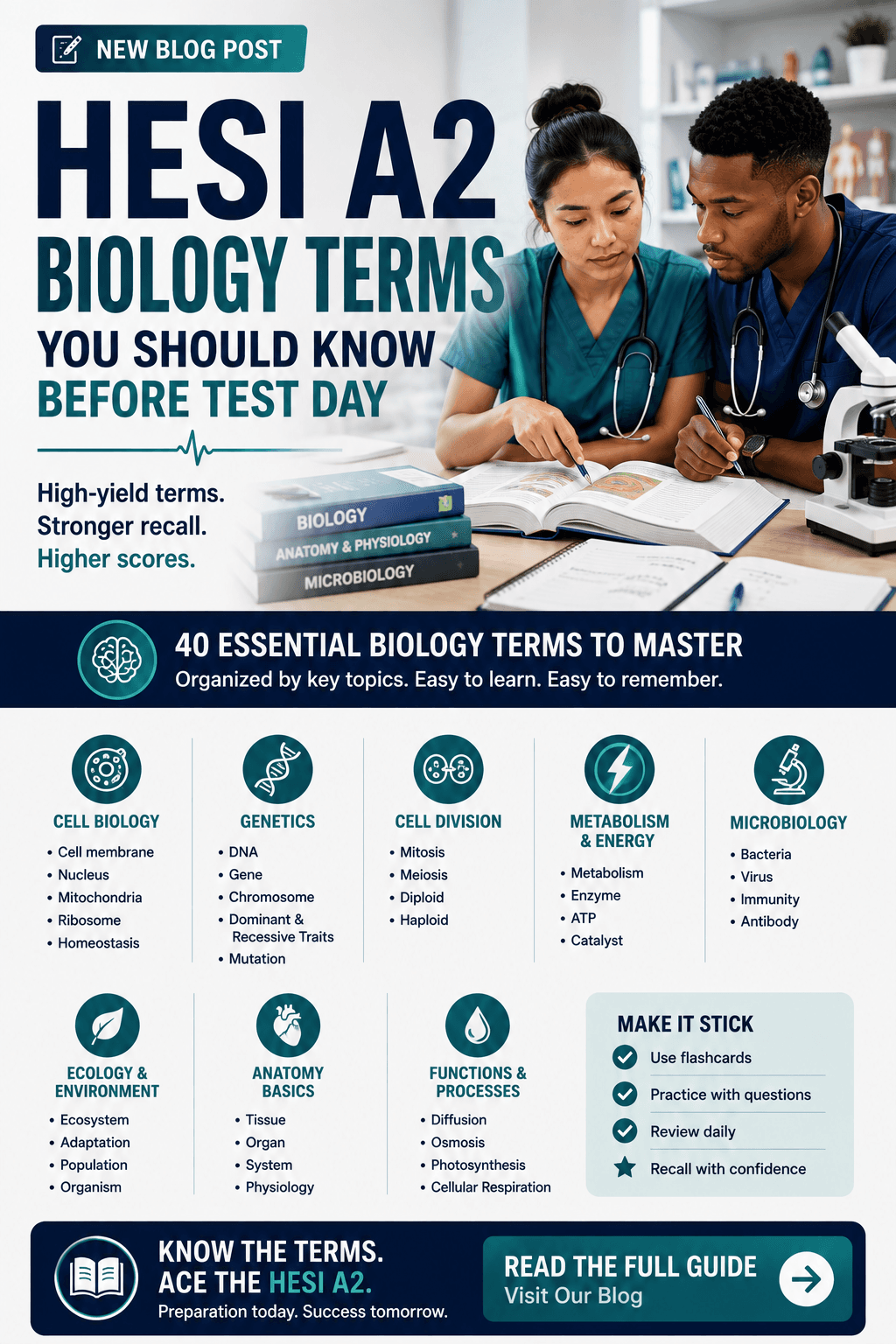
Terms in this set (40) Cell Biology
- Cell membrane – the outer boundary of a cell that controls what enters and leaves.
- Nucleus — the cell component that contains the genetic material and controls the cell’s activities.
- Cytoplasm — the gel-like fluid inside a cell where many cellular processes take place.
- Mitochondria – the organelle that produces cellular energy.
- Organelle A subcellular structure that performs a specific function.
- Ribosome - the structure within the cell that makes proteins.
- Homeostasis is the ability of the body to maintain a stable internal environment.
Genetics Glossary
- DNA — the molecule inside cells that carries genetic information.
- Gene — a segment of DNA that codes for a particular trait.
- Chromosome: a tightly coiled structure of DNA that contains genetic information.
- Dominant trait – a genetic trait that will be expressed if present, even if another version of the gene is also present.
- Recessive trait — a genetic trait that will require two matching copies to be expressed.
- Heredity — passing of genetic traits from parents to their offspring.
- Mutation — a change in the DNA sequence that can change genetic information.
Terms for Cell Division
- Mitosis – Cell division where one cell divides to form two identical cells.
- Meiosis – a special type of cell division that results in reproductive cells with half the normal number of chromosomes.
- Diploid -- a cell with two complete sets of chromosomes.
- Haploid – a cell containing only one set of chromosomes, as in reproductive cells.
Metabolism and Energy Vocabulary
- Metabolism — the chemical processes that take place in the body to turn food into usable energy.
- Enzyme—a protein which accelerates chemical reactions in the body without being consumed in the process.
- ATP (adenosine triphosphate) — the molecule that stores and transfers energy in cells.
- Catalyst — a substance that speeds up the rate of a chemical reaction.
Microbiology Terminology
- Bacteria – single-celled microorganisms, some of which are beneficial and some cause disease.
- Virus – a much smaller infectious agent that requires a host cell to replicate.
- Pathogen: any organism or agent that can cause disease.
- Immunity — the body’s ability to resist or fight off infection.
- Antibody — a protein made by the immune system to recognize and neutralize foreign substances, such as bacteria or viruses.
Environmental Biology and Ecology Terms
- Ecosystem – a community of living organisms interacting with their physical environment.
- Organism – any living individual.
- Adaptation — any structure that helps an organism survive and function in its environment.
- Population — a group of organisms of one species living in a certain area.
General Biology Terms Related to Anatomy
Due to some overlap between the HESI A2 biology and anatomy content, a few cross-referenced terms are also worth mentioning here.
- Tissue — a group of similar cells that work together to perform a specific function.
- Organ — a collection of different tissues that work together to perform a specific function.
- System — a group of organs that work together to perform a more general function within the body.
- Physiology — the study of how the parts of living things function.
Functions and Processes Terms
- Diffusion – process of movement of particles from an area of high concentration to an area of low concentration.
- Osmosis — the movement of water across a membrane from an area of low concentration of solute to an area of high concentration of solute.
- Photosynthesis - The process, by which plants convert sunlight into a chemical substance, is sometimes mentioned in broader biology questions.
- Cellular respiration – The process of cells converting nutrients into usable energy (NOT the respiratory system).
How to Make the Most of This List
When you study, put the terms into categories, rather than trying to memorize a single undifferentiated list. Related terms reinforce each other more effectively. Make flash cards of the words you do not know immediately and concentrate your review on those gaps.
Use each term in a sentence to reinforce understanding, not just memorizing an isolated definition. Connect terms to bigger ideas, such as “mitosis” with its purpose in growth and tissue repair, rather than memorizing definitions out of context.
Mistakes to Avoid
- Confusing similar sounding terms such as mitosis and meiosis without a good way to disambiguate.
- Memorizing definitions without context, which makes it difficult to apply the term correctly in an unfamiliar question.
- Ignoring less familiar words assuming they are less likely to appear when in fact even less common vocabulary can pop up unexpectedly.
In short,
The HESI A2 biology test is largely based on biology vocabulary so reviewing this list of high-yield terms in the days preceding your exam will help you recall and feel more confident. Instead of trying to relearn an entire biology course from scratch, use this focused vocabulary review as a final, efficient checkpoint – reinforcing the specific terms most likely to appear, and boosting your overall performance on test day.


