Where language provides an additional challenge
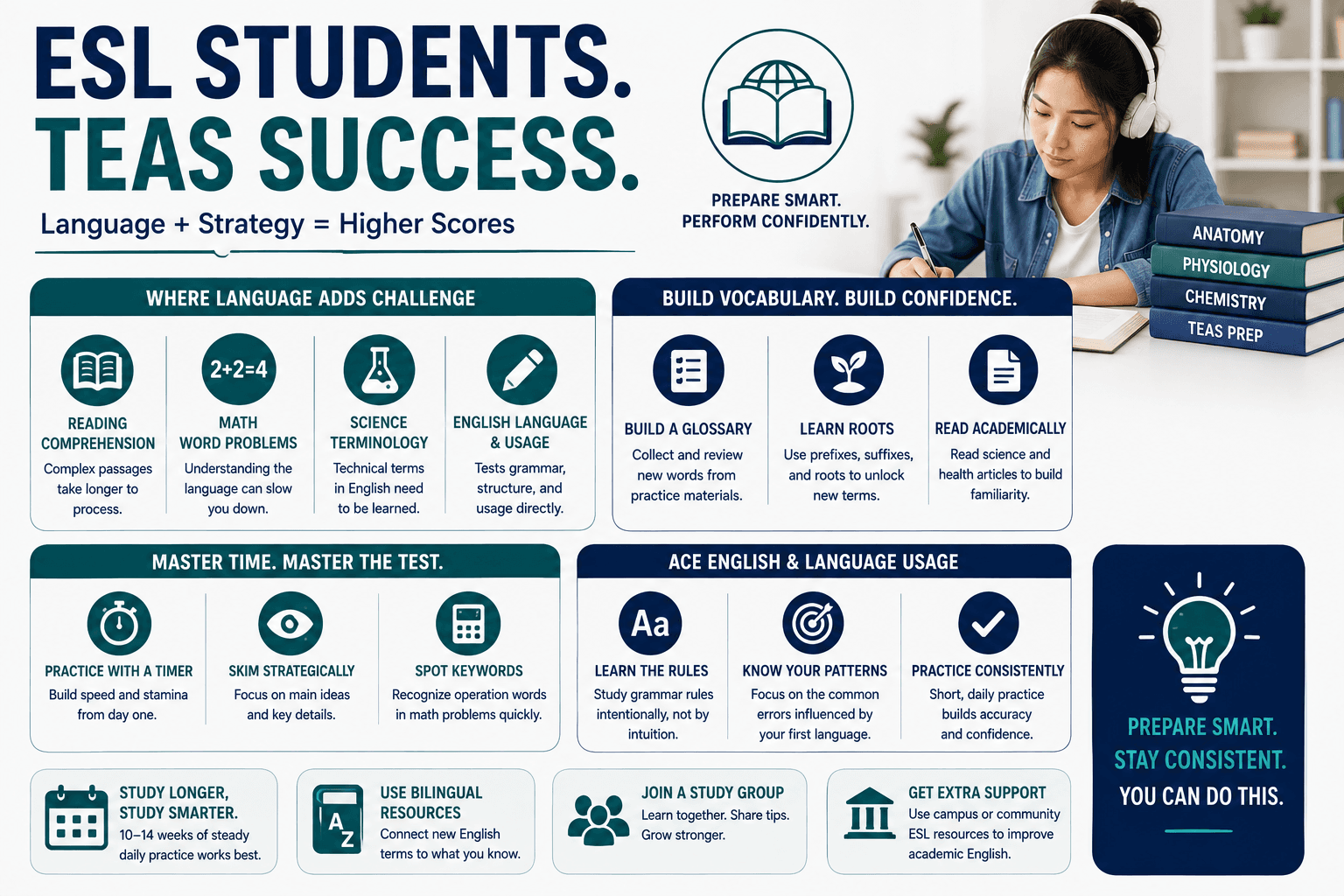
- Limited-time reading comprehension. Even excellent readers may struggle with timed comprehension in a second language because unfamiliar vocabulary or complex sentence structures take longer to absorb than in a first language. Conceptually the information may not be tough. But the pressure to decode it fast enough to answer inside the time restriction is different for native English speakers.
- Math word problems. Math abilities tend to transfer well between languages as numerical processes are mostly universal. But the math questions on the TEAS are often presented as word problems, meaning an ESL student who knows the arithmetic behind a question could still spend time, or make mistakes, just working to translate or interpret the language of the question itself.
- Technical/scientific terminology. The science section leans heavily on English technical vocabulary – words for body systems, biological processes and chemistry concepts. ESL students with a strong background in science education in another language may need to re-learn this vocabulary in English. The fundamental principles may already be recognizable, but not the terminology.
- English language and use mechanics. This section examines English grammar, sentence structure and patterns of usage directly and is therefore the section most directly connected to English proficiency itself rather than basic academic knowledge.
Effective Techniques for Building Vocabulary
- Instead of aiming to develop your English skills in general, which is a long-term goal and takes time, focus on building your vocabulary around the terms that are used repeatedly in TEAS content.
- Build a Running Glossary From Practice Materials Practice the practice questions and the official study guide. Write down any words you don’t know, especially science and academic words. Instead of trying to memorize a broad list of vocabulary, frequently reviewing this list will make sure that your work is going towards words you will really see on the exam.
- Learn root words for science words. Many anatomy and physiology terminology are built from a relatively small number of Greek and Latin roots, prefixes, and suffixes. If you learn those roots , rather than just remembering the words , you can determine words you have never encountered on the exam .
- Read academic English as part of your normal practice, not just test stuff. Even if you aren’t in school, reading scientific and health articles produced for a general audience helps you get comfortable with academic sentence structure and typical phrase patterns that are present throughout the TEAS.
How to Deal with Time Pressure
- Use a timer from the first day of practice, not just on test day. Getting comfortable with timed conditions early on (not just in the final practice examinations) helps you acquire an instinctive sense of pacing that is special to reading in a second language, so you’re not surprised by the time constraint for the first time on test day.
- Learn to skim strategically, not to read every word carefully. So while you are doing reading comprehension passages, focus on quickly grasping the main idea and important information instead of trying to completely translate or absorb every syllable. This ability, which is called strategic skimming, may be exercised on purpose and it tends to get better with experience.
- Keywords in Math Word Problems Know the words that indicate a mathematical operation (words that indicate addition, subtraction, ratios, or comparisons). The more you practice recognizing these words, the faster you will be able to get the relevant numbers and operation without having to interpret the entire sentence structure each time. Word problems require you to use language processing to solve math problems.
English and Language Usage Section Strategies
Don’t just learn grammar rules by intuition. Native speakers commonly determine grammar based on what "sounds right," but ESL students may have more luck with learning formal rules--subject-verb agreement, punctuation standards, sentence structure--as the intuition learned in a first language doesn't always transfer.
Look into frequent error patterns for your first language. Some native language speakers are more likely to make some grammatical errors due to the influence of their native language structure on their use of English patterns. If you know the faults you routinely make, whether it verb tense, article use or preposition choice, it’s more efficient to review those specific patterns rather than broad grammar.
Creating a Study Plan That Works
(For ESL students, the overall prep time will be greater than the six to eight weeks of study advised for native English speakers, because vocabulary building and language processing speed take longer to develop than topic review alone.) It’s often better to work on it every day for ten to fourteen weeks, rather than a few long sessions, as it tends to lead to more consistent gains, especially in reading speed and vocabulary retention.
Additional Resources to Consider
If you can find bilingual glossaries of science vocabulary, they can help you connect the new English terms with concepts you may already understand well in your native language, speeding up comprehension, instead of making you learn both the subject and the vocabulary at the same time.
English language support services are generally located at community colleges or public libraries, or you may find them through your required coursework institution. English language support services can complement your TEAS-specific prep with broader academic English support if you are still struggling with reading speed or grammar.
Study groups with other ESL applicants can be very beneficial, as peers with similar language issues can share unique vocabulary tactics and discover shared error patterns that a broad study guide won't address.
The Bottom Line
ESL students who are preparing for the TEAS are doing two things simultaneously: they are learning academic information and they are processing academic content quickly in a second language. Because difference lends itself to a more focused prep strategy — one that actively generates test-specific vocabulary, performs timed reading and skimming as a standalone skill, and examines English grammar directly, not just intuitively. With a realistic, extended timeline and frequent practice, ESL applicants routinely earn good TEAS scores. The preparation merely needs to be honest about where language, not just topic understanding, is adding to the burden.