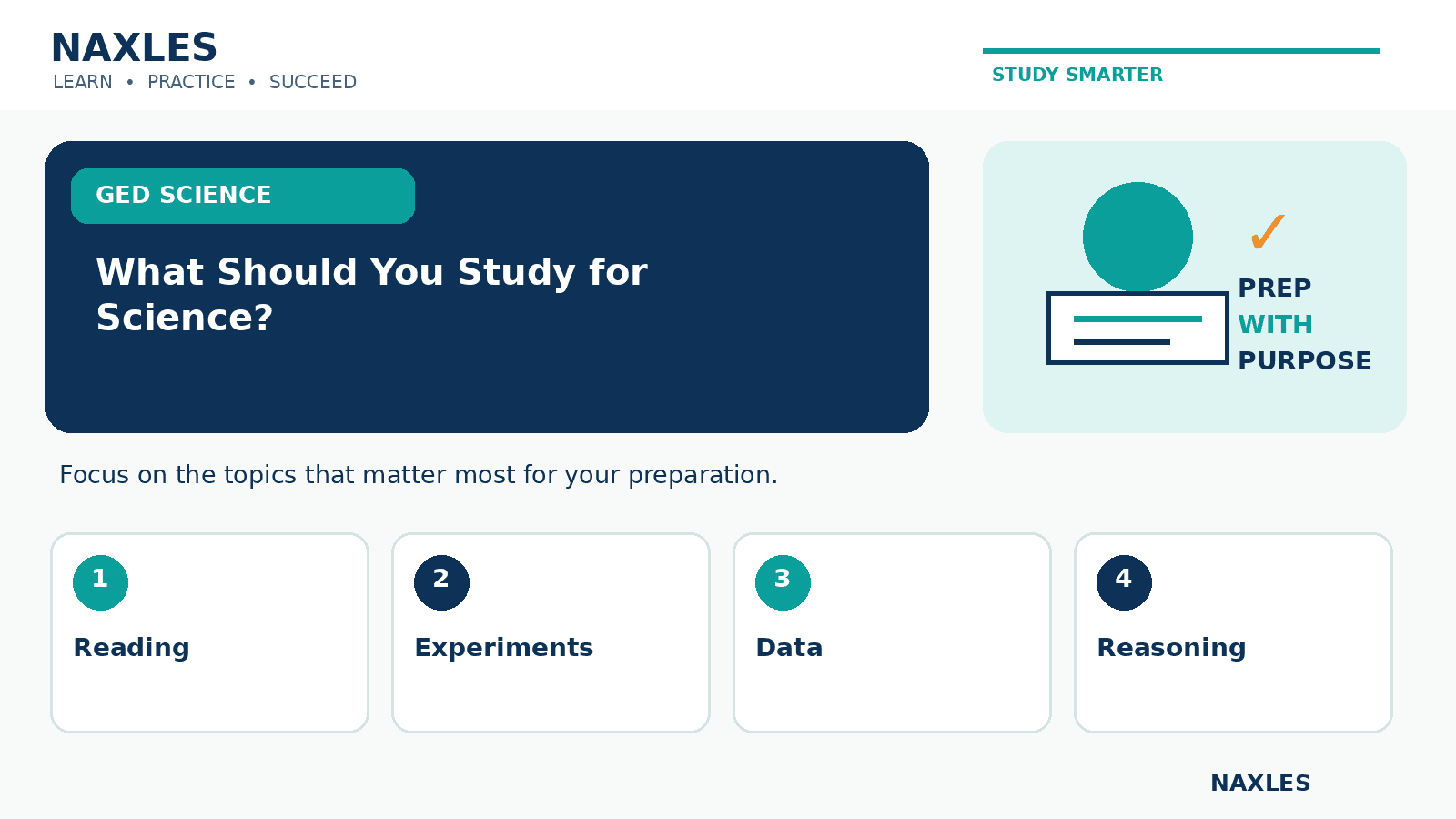
GED Science: What Should You Study?
GED Science preparation is not only about memorizing scientific facts. The test also asks you to understand scientific information, interpret data, and reason from evidence. Knowing this can help you prepare more effectively.
What Does GED Science Test?
The GED Science test focuses on three broad areas:
- Reading for meaning in science
- Designing and interpreting scientific experiments
- Using numbers and graphics in science
This means that reading and reasoning skills are important alongside your science knowledge.
Practice Reading Scientific Information
You may encounter passages containing scientific information. Practice identifying:
- The main idea
- Important evidence
- Relationships between ideas
- Conclusions supported by the passage
Don't assume that every sentence contains information you need to memorize.
Understand Experiments
You should also be comfortable interpreting basic scientific experiments. Review concepts such as:
- Variables
- Controls
- Experimental groups
- Observations
- Conclusions
- Evidence
When looking at an experiment, ask what the researchers changed, what they measured, and what conclusion the results support.
Practice Graphs and Tables
Scientific information is often presented visually. Practice reading:
- Tables
- Line graphs
- Bar graphs
- Diagrams
- Data displays
Look for patterns, comparisons, increases, decreases, and relationships.
Don't Rely Only on Memorization
Memorizing science facts can help, but it should not be your entire study strategy. GED describes the Science test as emphasizing the ability to understand science concepts, interpret scientific information, and use reasoning. Practice applying information to new situations.
How Long Is GED Science?
The GED Science test has a 90-minute time limit. Use practice tests to become comfortable reading scientific passages and analyzing information within that time.
Final Thoughts
Prepare for GED Science by combining science knowledge with reading, data interpretation, and reasoning practice. Work with graphs and experiments regularly and make sure you can explain why an answer is supported by the information provided.