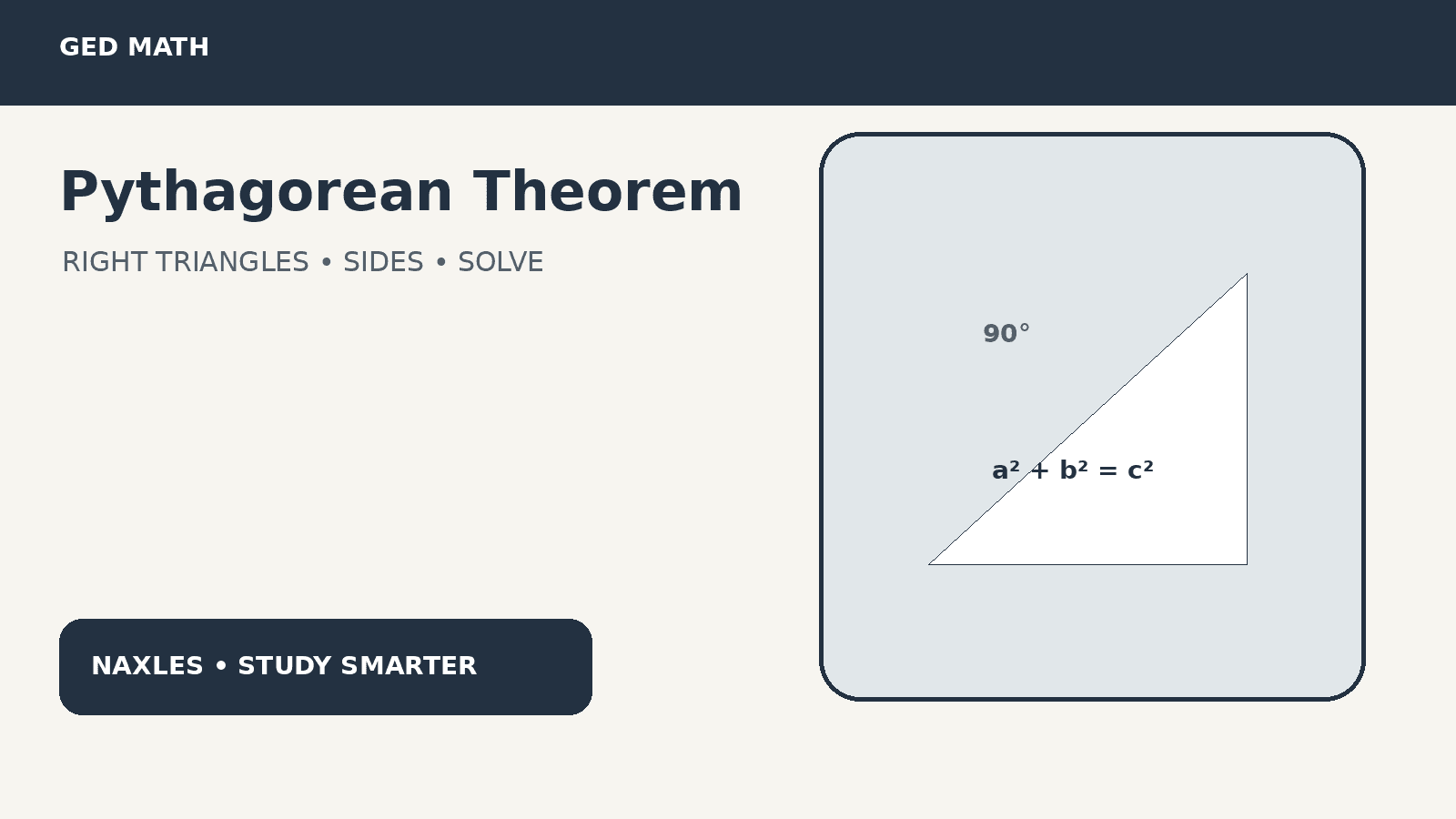
GED Math: Using the Pythagorean Theorem
Geometry questions can seem intimidating when diagrams are involved, but some problems rely on a simple relationship between the sides of a right triangle. That relationship is known as the Pythagorean theorem.
The Formula
The formula is: a² + b² = c² Here: a and b are the legs of the right triangle. c is the hypotenuse. The hypotenuse is always the side opposite the right angle and is the longest side of a right triangle.
Example
Suppose a right triangle has legs measuring: 3 and 4 Use: 3² + 4² = c² Therefore: 9 + 16 = c² 25 = c² Taking the square root: c = 5
Finding a Missing Leg
You can also use the formula when the hypotenuse and one leg are known. Suppose: c = 13 and: a = 5 Then: 5² + b² = 13² So: 25 + b² = 169 Therefore: b² = 144 and: b = 12
Identify the Right Angle First
The Pythagorean theorem applies specifically to right triangles. Before using the formula, look for the right-angle marker or information indicating that the triangle has a 90-degree angle.
Watch the Square Root
If you solve for a squared variable, remember that you need to take the square root at the end. For example: x² = 49 means: x = 7 for a positive side length.
Check Your Answer
The hypotenuse should be longer than either leg. If you calculate a hypotenuse that is smaller than one of the legs, check your work.
Final Takeaway
Remember the relationship a² + b² = c², identify the hypotenuse correctly, and work through the calculation one step at a time.