GED Math: Ratios and Proportions
Ratios are used to compare quantities. Proportions allow you to determine an unknown quantity when two ratios represent the same relationship. These concepts can appear in practical word problems involving prices, recipes, distances, and measurements.
What Is a Ratio?
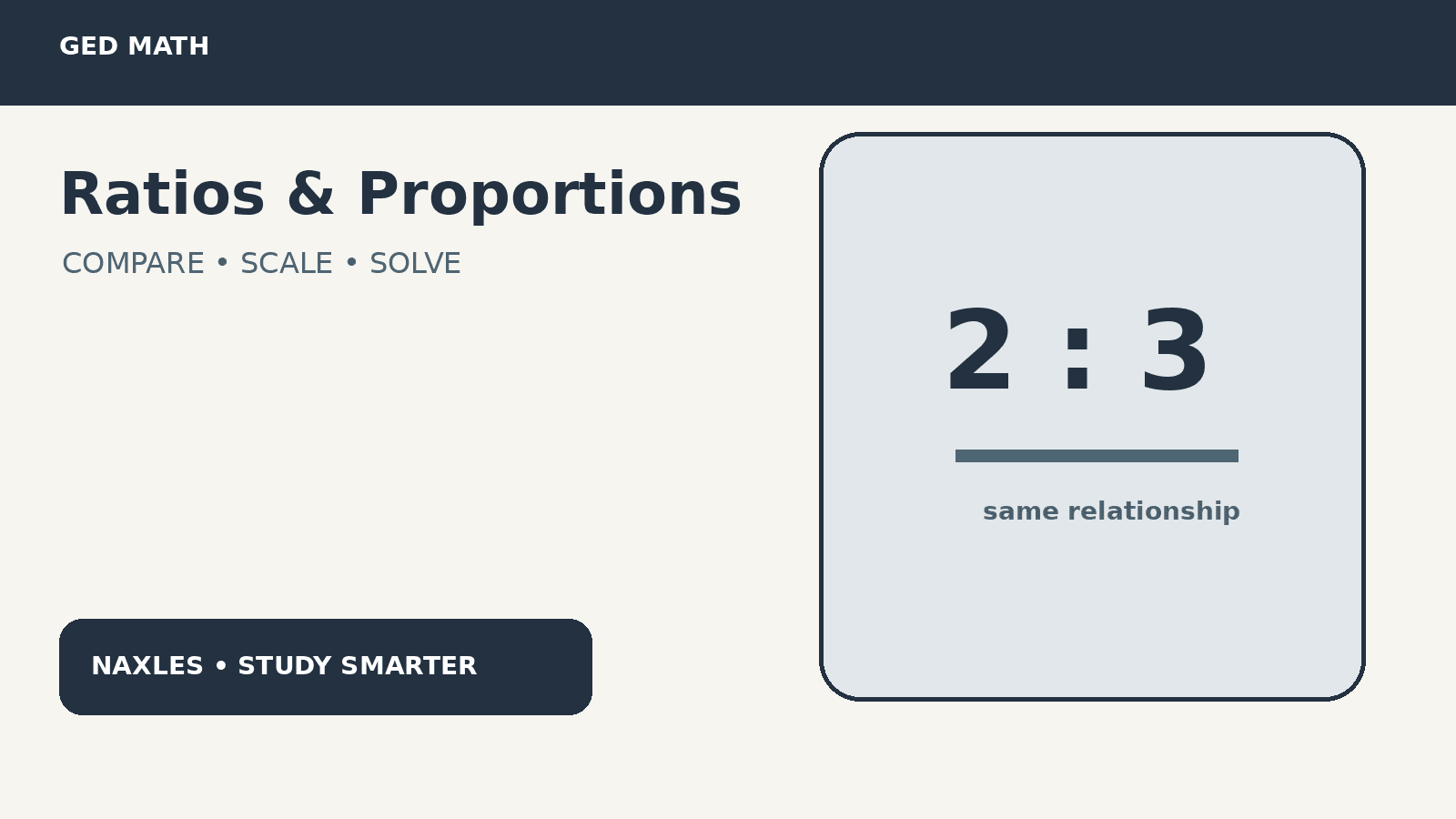
A ratio compares two quantities. For example: 2 red pens : 3 blue pens can be written as: 2:3 This means that for every 2 red pens, there are 3 blue pens.
Equivalent Ratios
Equivalent ratios represent the same relationship. For example: 2:3 and 4:6 are equivalent because both numbers in the first ratio were multiplied by 2.
Setting Up a Proportion
Suppose 3 notebooks cost $6. How much would 5 notebooks cost at the same rate? You can set up: 3/6 = 5/x Then solve for x. Cross multiplication gives: 3x = 30 Therefore: x = 10 The answer is $10.
Keep Units Consistent
When solving word problems, make sure corresponding quantities are matched correctly. For example: notebooks / dollars should remain consistent on both sides of the proportion.
Scale Problems
Ratios are also useful when scaling recipes, drawings, maps, or models. If a recipe serves 4 people and you need to serve 8, the quantities may need to be doubled.
Check Whether Your Answer Makes Sense
If you are buying more items at the same price per item, the total cost should increase. If your answer is smaller than the original cost, check your setup.
Final Takeaway
For GED ratio and proportion problems, identify the quantities being compared, keep the units consistent, set up equivalent relationships, and check whether your answer makes practical sense.