GED Math: A Step-by-Step Guide to Solving Word Problems
Word problems can be challenging because they require more than performing calculations. You first need to understand the situation, identify the information that matters, and decide which mathematical operation or equation to use. For GED Mathematical Reasoning preparation, practicing a consistent method can make word problems easier to organize. You do not need to solve every question immediately. Start by understanding what the question is asking.
Step 1: Read the Entire Problem
Read the question carefully before reaching for a calculator. Identify the situation being described and what you need to find. For example: A store sells notebooks for $3 each. If a student buys 5 notebooks, how much will the student pay before tax? The question asks for the total cost of five notebooks. You know the price of one notebook and the number purchased.
Step 2: Identify the Important Information
Write down the numbers and units that matter. In the notebook example: Price per notebook: $3 Number of notebooks: 5 Total cost: unknown This step helps prevent you from overlooking information or using the wrong number.
Step 3: Choose the Correct Operation
Think about the relationship between the quantities. If the price is the same for every notebook, multiplication is appropriate: 3×5=15 The total cost is $15 before tax. Some problems involve more than one operation. For example, a question might ask you to calculate the total cost after a discount. You may need to find the discount first and then subtract it from the original price.
Step 4: Set Up an Equation When Needed
For more complicated questions, an equation can help represent the unknown quantity. Consider this example: A taxi charges a fixed fee of $4 plus $2 for every mile. What is the fare for a 6-mile trip? Let x represent the total fare. x=4+2(6) x=4+12 x=16 The fare is $16. Writing an equation helps you keep the fixed fee and the mileage charge separate.
Step 5: Check Whether the Answer Makes Sense
After calculating, review your answer in the context of the problem. If five notebooks cost $3 each, a total of $15 is reasonable. A total of $8 or $150 would suggest that you should recheck your calculation or the way you interpreted the question. Pay attention to units, too. A distance might be measured in miles, a price in dollars, or a quantity in pounds.
Common Word-Problem Mistakes
One common mistake is choosing an operation based only on a keyword. Words such as more, less, and each can provide clues, but they do not always determine the operation by themselves. Another mistake is answering a different question from the one asked. If a problem asks for the total cost, calculating only the cost of one item is not enough. Finally, avoid rushing through the reading. A small detail such as a discount, a fixed fee, or a unit conversion can change the calculation.
How to Practice GED Word Problems
Start with one-step questions involving addition, subtraction, multiplication, and division. Then move to questions that require two or more steps. After each practice question, explain why you chose a particular operation. If you make a mistake, identify whether it came from reading the question, setting up the equation, or calculating.
Final Thoughts
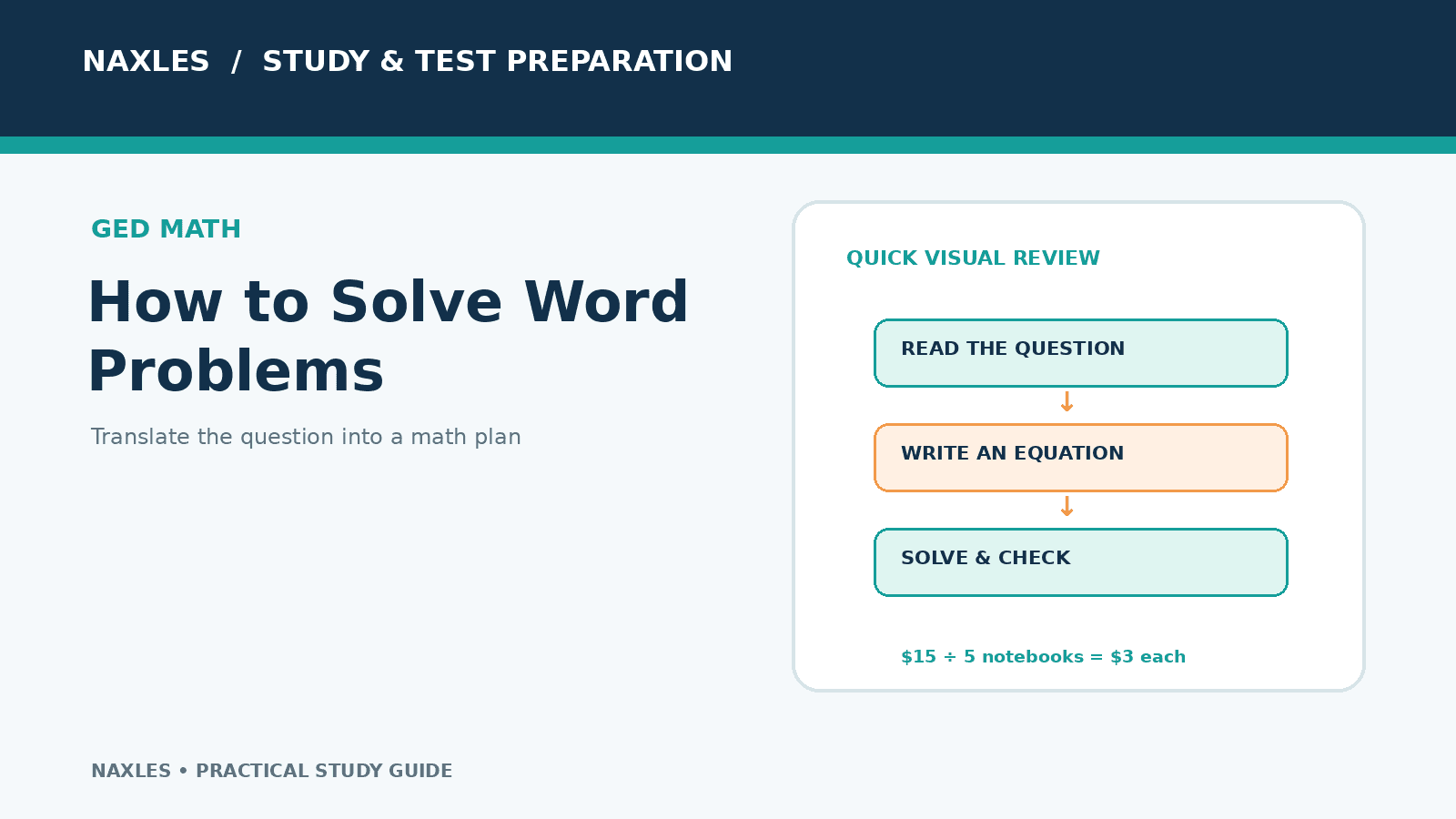
A reliable approach to word problems is to read, identify the information, choose a method, calculate, and check. With regular practice, you can become more comfortable translating written situations into mathematical expressions.