GED Math: Fractions and Decimals Made Simple
Fractions and decimals are used to represent parts of a whole. They appear in everyday situations such as measuring ingredients, calculating prices, and comparing quantities. They are also important topics to review when preparing for the GED Mathematical Reasoning test. If fractions and decimals seem confusing, begin with the basic meaning of each one. Once you understand how they represent quantities, comparing and calculating with them becomes easier.
1. Understanding Fractions
A fraction represents part of a whole. It has two main parts: Numerator: The number on top, showing how many parts are being considered. Denominator: The number on the bottom, showing how many equal parts make up the whole. For example, in the fraction 3/4, the whole is divided into four equal parts, and three of those parts are being considered. Fractions can sometimes be simplified. For example: 8 6 = 4 3 Both fractions represent the same quantity. To simplify a fraction, divide the numerator and denominator by the same nonzero number that divides them evenly.
2. Comparing Fractions
When fractions have the same denominator, comparing them is straightforward. For example: 8 3 < 8 5 Both fractions represent eighths, and five eighths is greater than three eighths. When fractions have different denominators, you can convert them to equivalent fractions with a common denominator. For example, compare 1/2 and 2/3. Convert them to sixths: 2 1 = 6 3 3 2 = 6 4 Since 4/6 is greater than 3/6, 2/3 is greater than 1/2.
3. Converting Fractions to Decimals
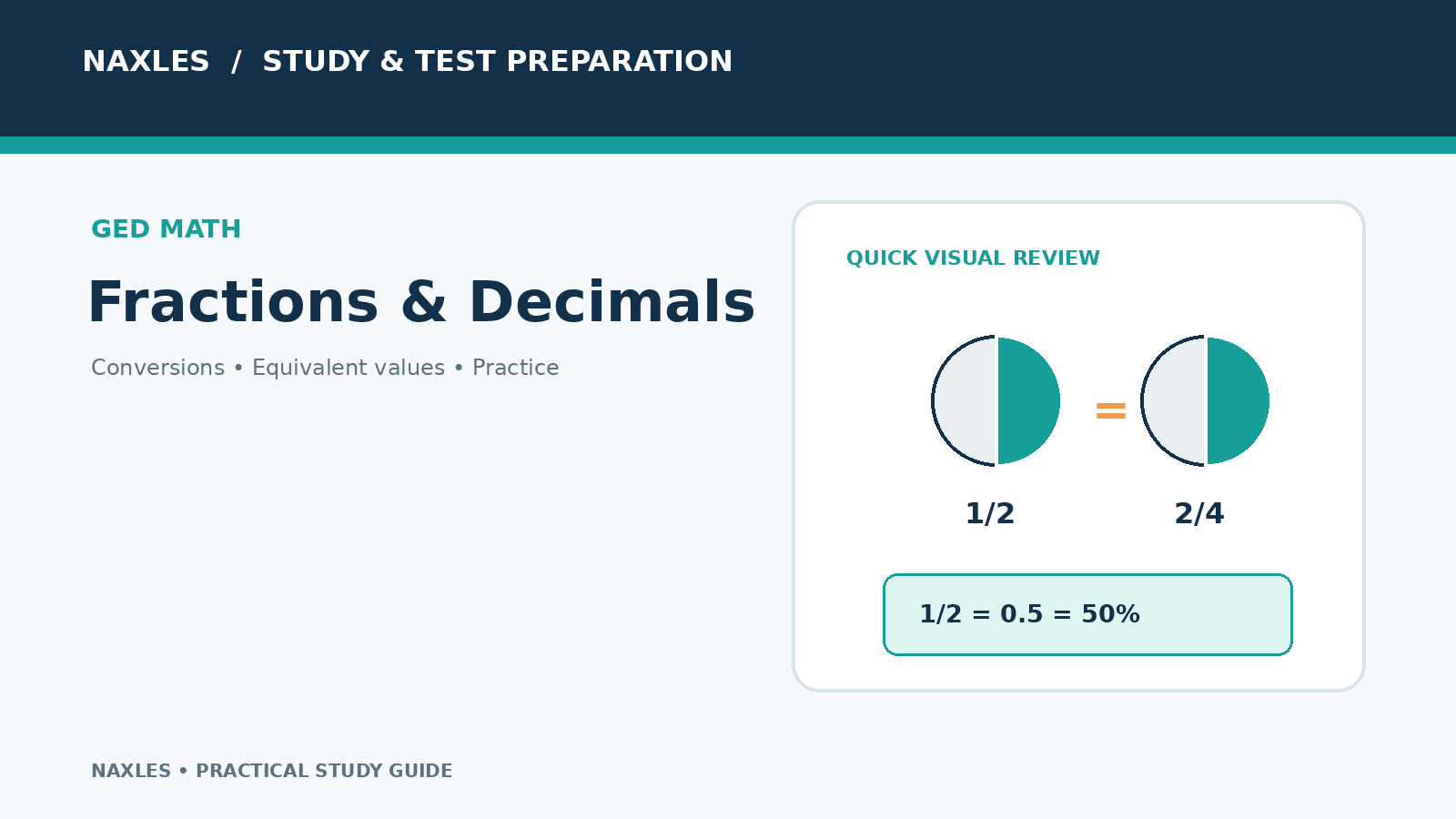
To convert a fraction to a decimal, divide the numerator by the denominator. For example: 4 3 =3÷4=0.75 Another example is: 2 1 =1÷2=0.5 Some fractions produce repeating decimals. For example, 1/3 equals approximately 0.333 when rounded to three decimal places. Pay attention to whether a question asks for an exact answer or a rounded decimal.
4. Converting Decimals to Fractions
You can convert a terminating decimal into a fraction by using its place value. For example, 0.6 means six tenths: 0.6= 10 6 Simplify by dividing the numerator and denominator by 2: 10 6 = 5 3 Similarly, 0.25 means twenty-five hundredths: 0.25= 100 25 = 4 1 Remember to simplify the fraction when possible.
5. Adding and Subtracting Fractions
When fractions have the same denominator, add or subtract the numerators and keep the denominator unchanged. For example: 7 2 + 7 3 = 7 5 For fractions with different denominators, find a common denominator first. For example: 2 1 + 4 1 Convert 1/2 to 2/4: 4 2 + 4 1 = 4 3 The same principle applies to subtraction.
6. Multiplying and Dividing Fractions
To multiply fractions, multiply the numerators together and the denominators together. 3 2 × 4 3 = 12 6 = 2 1 To divide fractions, multiply the first fraction by the reciprocal of the second fraction. For example: 3 2 ÷ 4 1 = 3 2 × 1 4 = 3 8 You can express 8/3 as 2 3 2 if a mixed number is appropriate.
7. Estimate to Check Your Answer
Estimation can help you identify calculation errors. For example, if you are adding 0.49 and 0.52, you can estimate each number as approximately 0.5. The total should be close to 1. If your calculated answer is 10, you should review your work because it is far from the estimate.
How to Practice Fractions and Decimals
Start by simplifying fractions and converting between fractions and decimals. Then practice comparing values and performing calculations. Once you are comfortable with the basics, try word problems involving prices, measurements, and quantities. These can help you practice choosing the right operation and interpreting the answer. The official GED test subjects page lists basic math among the topics covered in Mathematical Reasoning. GED
Final Thoughts
Fractions and decimals become easier when you understand how they represent parts of a whole. Practice simplifying, converting, comparing, and calculating with them. Check your answers using estimation, and review any steps that repeatedly cause mistakes.