The Popularity of Flashcards
Flashcards have existed for a reason:
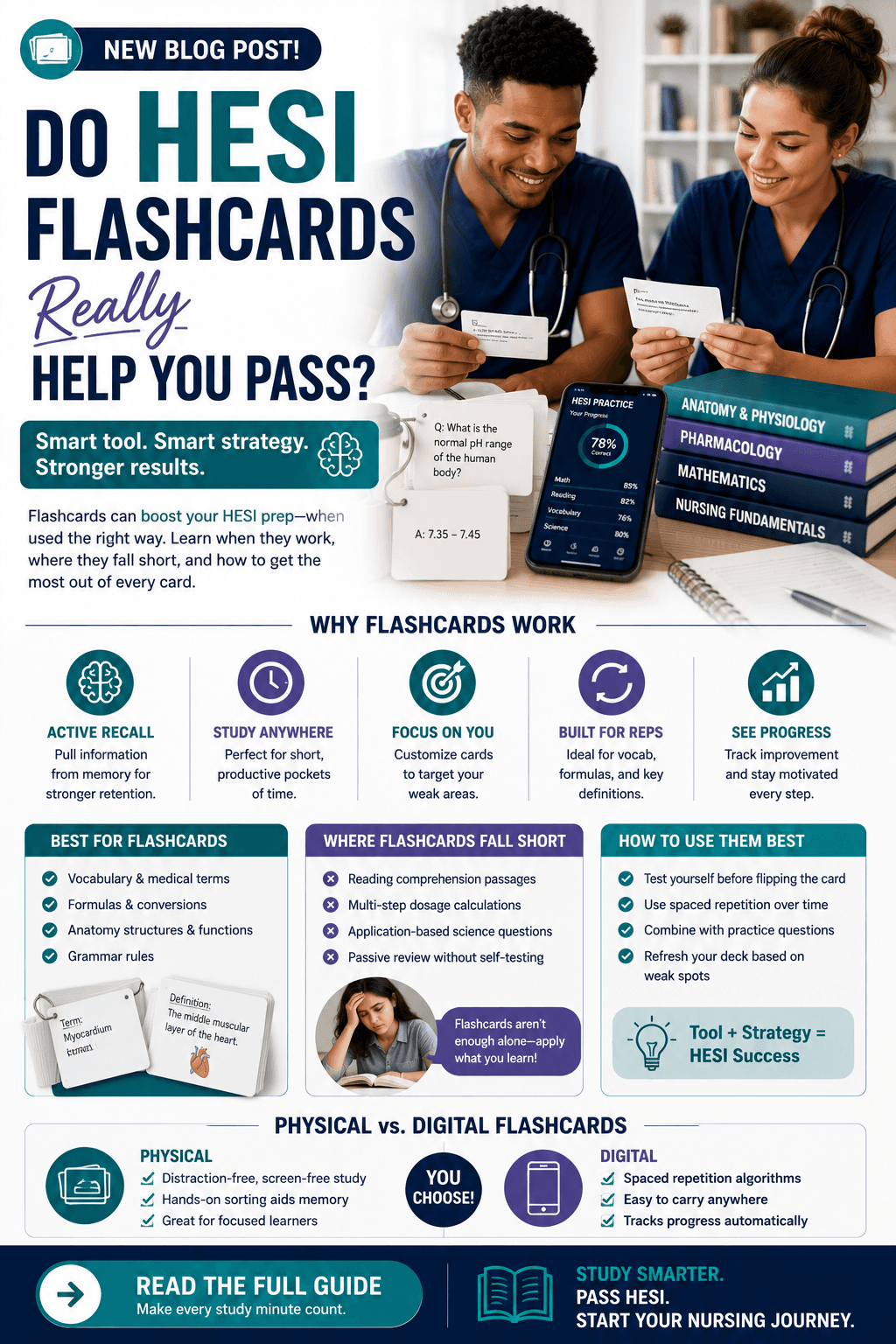
- They are simple, portable, and they align well with a well-documented learning technique called active recall.
- They are easy to use, so they can be squeezed into short pockets of free time during the day.
- They force active recall, which means you are not just recognizing, but also actually pulling information out of memory.
- They are easy to tailor and you can focus specifically on your own weak areas instead of generic content.
- They are great for content that relies on repetition, like vocabulary, formulas and key definitions.
Where flashcards really come in handy
Flashcards are often most useful for certain types of HESI content, especially those that call for memorization and quick recall.
- Vocabulary and medical terminology — flashcards are awesome for getting familiar with definitions and usage.
- Formulas and conversions – going over dosage calculation formulas repeatedly helps to make them second nature.
- Anatomy structures and functions — flashcards can reinforce the names and functions of body systems, organs and structures.
- Grammar rules – short, rule-based grammar concepts are a good fit for a flashcard format.
For this type of content, flashcards are a very effective way of developing rapid and reliable recall through repetition.
Where Flashcards Fail
Flashcards are a helpful tool but they have real limitations especially for certain parts of the HESI exam.
- Reading comprehension is not a skill that can be easily flash carded. This skill depends on understanding complete passages, rather than isolated pieces of information.
- To learn complex problems such as multi-step dosage calculations, the entire process must be practiced, not just memorizing a formula in isolation.
- Science questions that are application-based frequently need an understanding of how concepts relate to each other, which flashcards cannot fully capture on their own.
- Passive flashcard review — just going through the cards without testing yourself can give you a false sense of knowing the material, without really cementing it in your memory.
How to Use Flashcards to Your Advantage
- Flashcards are best used as part of a broader study strategy, not as a stand-alone solution.
- Do not just rely on generic pre-made sets. Build your own flashcards for your particular trouble spots.
- Try to remember the answer before you look at the back of the card – do not just passively read the cards.
- Use spaced repetition, which involves reviewing cards at increasing intervals over time, instead of cramming the same set repeatedly in one session.
- Combine flashcards with practice questions. Flashcards aid in quick information recall, and practice questions assist in applying this knowledge contextually.
- Periodically, take out cards you have mastered and put in new cards as you find areas of weakness through practice testing, to keep your deck fresh.
Physical Flashcards vs. Digital Flashcards
Both formats have their benefits and the choice is often a matter of personal preference.
- Many digital flashcard apps use spaced repetition algorithms that show you the cards you struggle with more often.
- Physical flashcards offer a distraction-free, screen-free way to study that some students find easier to focus with.
- Digital versions are easier to carry around for those little pockets of downtime during the day.
- Physically sorting and reviewing the cards may help students remember.
Conclusion
Flashcards can certainly help you to study for the HESI exam, but how effective they are will depend on how they are used and the content they are used with. They are great for vocab, formulas, and basic recall stuff. However, they should not be a full replacement for practicing full-length questions, timed sections, and application based reasoning. When used with practice tests, content review, and reading comprehension practice as part of a larger study strategy, flashcards can be a great way to improve your memory and confidence on exam day.