Why Chemistry Is Ignored
Chemistry can be so far apart from nursing that anatomy isn’t. It's tempting to think of " Science " as largely the human body. However, chemistry is a TEAS 7 curriculum area that’s unique and different from the anatomy & physiology and biology sections, and it’s very important for your Science composite score. One of the greatest preventable point losses on this part is to treat it as optional.
The Periodic Table: What You Need to Know
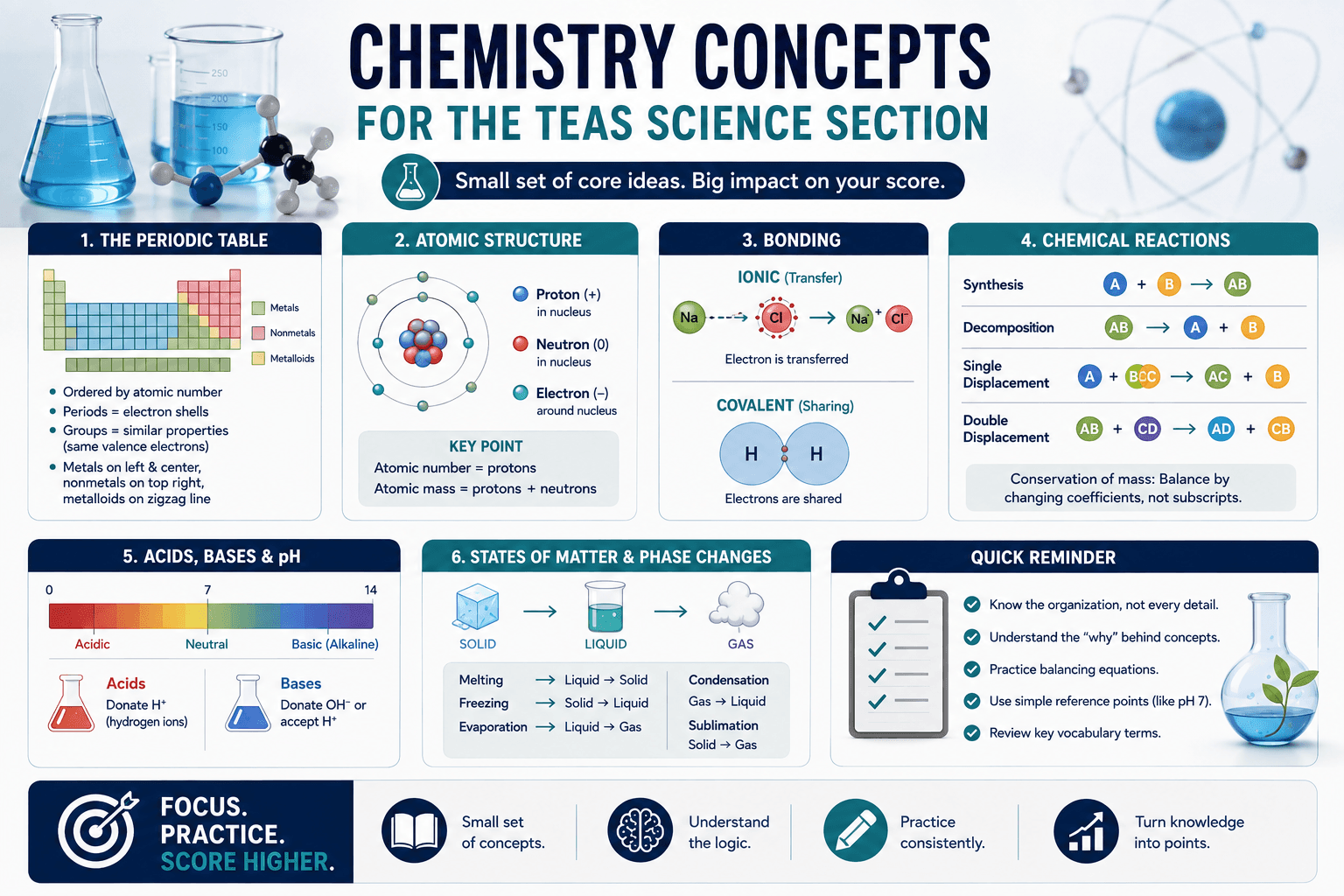
You don’t need to memorize the complete periodic table, but you should comprehend the essential organization of it:
- Elements are ordered by atomic number (number of protons).
- The periods (rows) tell how many electron shells there are.
- Elements in the same group (column) have the same number of valence (outermost) electrons and therefore similar chemical characteristics.
- Metals are in the general areas of the table on the left and center; nonmetals are in the top right; and metalloids are along the zigzag dividing line between them.
Tip for solving the problem: Instead of trying to memorize the particular facts about the different elements in isolation, learn why the table is ordered in the manner it is. They typically test you on this logic instead of making you memorize atomic numbers.
Basics of Atomic Structure
Identify the three main subatomic particles and their properties:
- Protons: positively charged, found in the nucleus, determines the element identity.
- Neutrons: have no charge and are found in the nucleus, contributing to atomic mass.
- Electrons: negatively charged, orbit the nucleus, take part in chemical bonding
Problem-solving tip: Students often confuse atomic number (number of protons) with atomic mass (number of protons + number of neutrons). Atomic number is how you tell what element it is Atomic mass is the total weight of protons and neutrons.
Bonding (Chemical)
Know the two main types of bonds which are being tested:
- Ionic bonds: created by the transfer of electrons from one atom to another (usually a metal to a nonmetal), forming charged ions that attract each other.
- Covalent bonds: When electrons are shared between atoms. Usually between two non-metals.
Problem-solving tip: A helpful memory anchor: ionic bonds include giving/taking electrons (imagine “ionic” as in one atom becomes an ion by losing or gaining electrons), while covalent links involve sharing electrons constructively.
Chemical Reactions and Equations
Learn the fundamental types of chemical reactions:
- Synthesis: the combination of two or more substances to create a new substance.
- Decomposition: One compound can be decomposed into two or more simple compounds.
- Single displacement: One ingredient replaces another in a compound.
- Double replacement: two compounds exchange parts to generate two new compounds
The concept of conservation of mass is the basic idea in balancing equations. The number of atoms of each element must be the same on both sides of the equation. Balancing changes coefficients (the numbers in front of chemical formulas), never the subscripts inside a formula.
Tip for problem solving: Balance basic equations one element at a time, checking both sides of the equation, instead of trying to balance everything in your head at once.
Acids / Bases and pH
Understand the basic pH scale: under 7 is acidic, 7 is neutral and over 7 is basic (alkaline). Acids give off hydrogen ions in solution, while bases either give off hydroxide ions or receive hydrogen ions.
Solve- it- by- analogy tip: Connect this idea to concrete reference points that are easy to remember when you're stressed -- for instance, recollect that water is neutral (pH 7) as a solid fixed point to compare to when figuring out if other mentioned materials are more or less acidic or basic.
States of Matter and Changing Phases
Know the three states of matter (solid, liquid, gas) and the words for changing between them: melting (solid to liquid), freezing (liquid to solid), evaporation (liquid to gas), condensation (gas to liquid) and sublimation (solid straight to gas).
Problem-solving tip: These terms are often examined with direct vocabulary recognition rather than sophisticated application, therefore they are some of the most efficient points accessible in this content area for a relatively short time investment.
Common Issues and Solutions
Problem: "I've been skipping chemistry because I thought Science was all about anatomy." Solution: Schedule dedicated, protected time to study chemistry, as it is assessed as a stand-alone category, not as part of anatomy and physiology.
Problem: “I confuse ionic and covalent bonds.” Solution: Tie the difference to the basic process: moving electrons (ionic) versus sharing electrons (covalent). Do not memorize examples of compounds without understanding the process.
Problem: “I don’t know how to balance chemical equations.” Solution: Try to verify one thing at a time on both sides of the equation, and simply change the coefficients, don't try to balance the whole equation intuitively at one go.
Problem: “I mix up my atomic number and atomic mass. Solution: Get the definitions straight in your mind: atomic number is protons only; atomic mass is protons plus neutrons together.
Problem: “Chemistry feels like the part that gives me the least return on my limited study buck.” More often the reverse is true. A targeted review here can easily yield significant score increases since chemistry is built on a very limited collection of key concepts rather than a huge volume of material, as is the case with broader curriculum areas.
Summary
Chemistry isn’t quite as memorization-intensive as anatomy and physiology, so it’s one of the better areas to shore up if it’s a poor subject for you. We focus on organizing the periodic table, atomic structure, forms of bonding, types of reactions and balancing equations, basics of pH, and language for phase changes. It’s a reasonably compact set of topics, and if you get them down, they transform straight into points you may earn on test day.