Why Prep Courses Aren’t Absolutely Necessary
TEAS examines basic academic knowledge in reading, arithmetic, science, and English and language usage — subject that most applicants have already seen in high school or general education curriculum. A prep course is less about teaching new content and more about organizing study, providing practice questions, and getting you comfortable with the exam's format and speed. All three of those things can be achieved without investing in a paid course, if you’re prepared to develop the structure yourself.
The official study guides, free practice tools and diligent evaluation of their own classroom notes help many successful test-takers pass the exam. A course mainly gives you convenience and accountability, not access to material you can’t find elsewhere.
When it’s effective to prepare on your own
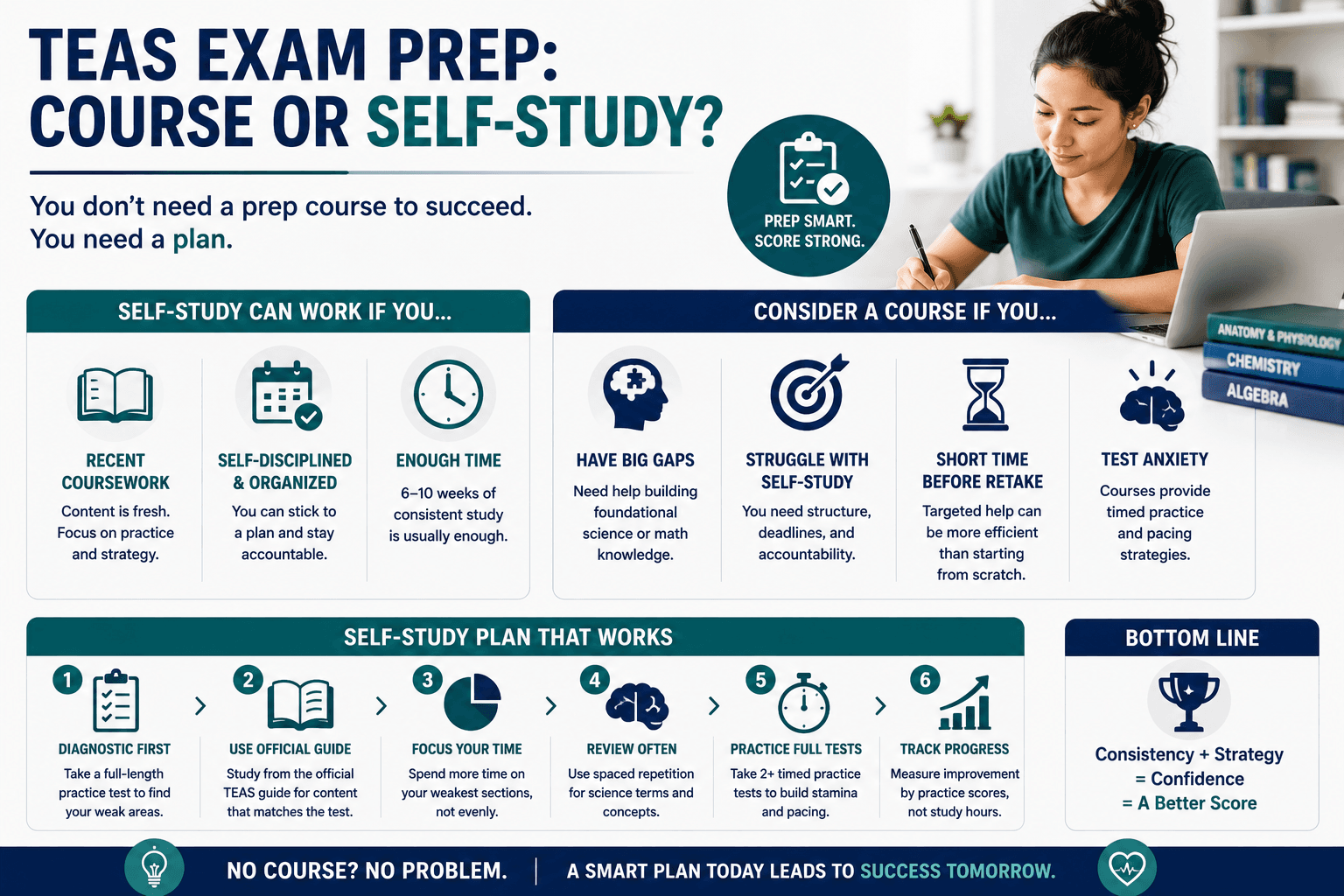
Self-study can be successful for applicants who fulfill one or more of the following profiles:
- Recent or present coursework in tested content areas." If you have taken anatomy and physiology, algebra, or chemistry in the last year or two, the information is probably still rather fresh and you can spend your preparation time getting familiar with the format and doing targeted review rather than relearning content from scratch.
- Good time management and self-discipline. Self-study means you choose your own plan and you stick to it and you are honest about your weaknesses without someone else pointing them out to you. Students who have done well self-studying for other standardized tests, or who are good at independent study in other situations, do OK without a course.
- A reasonable prep schedule. Generally, six to ten weeks of steady, organized self-study is typically enough to prepare thoroughly for the TEAS, unless you have a large material gap in several sections to close.
When It’s Worth Considering a Prep Course (or More Organized Help)
- Self-directed study isn’t for everyone and it’s good being honest about which category you fall into before committing to a fully independent approach.
- Large gaps in basic science and/or math. If it's been many years since you did biology, chemistry, or algebra — or you never took some of these courses at all, a course or a tutor can help you gain content knowledge more rapidly than working through a study guide alone, especially for science topics that build upon each other.
- Hard to keep to a self-imposed schedule. If you’ve ever tried self-study for other exams or courses and it went apart without an external structure, the structure, deadlines and responsibility of the instructor incorporated into a course can be worth the money simply because it raises the likelihood you actually finish your prep.
- Small window before a retake. If you have previously taken the TEAS once and scored below your target, and you have a short deadline for a necessary repeat, a short, tailored course or tutoring that particularly targets your weak subsections can be more time efficient than rebuilding a self-study plan from beginning.
- Test anxiety or not used to standardized testing. If you struggle with multiple-choice tests when you're under time pressure, even if you know the material well, a course that provides full-length timed practice exams and pacing tactics will tackle that specific issue more directly than content study alone.
Creating a Successful Self-Directed Study Plan
If you opt to prepare without a course, an organized strategy is more important than the exact materials you use.
- Begin by taking a diagnostic practice test. Start by taking a full-length practice test under timed conditions to see where you're really poor before you begin studying. This avoids the frequent error of spending too much time on topics you are already good at, while ignoring the ones that are bringing your score down.
- Use the official study guide as a basis. The organization that administers the TEAS produces an official study material that is very closely tied to the real exam content and format. If you base your review on this resource, rather than general resources from other sources, you will ensure that your practice is what you will actually see on exam day.
- Use your diagnostic results to develop a section-by-section schedule. Spend more time on your weaker areas instead of trying to split your time equally across all four. For instance, if your biggest gap is science, you should arrange the biggest chunk of your study calendar for science.
- Add spaced repetition specifically for science . Science knowledge in particular is more apt to require distributed review throughout time and not just one marathon study session . Anatomy terms and physiological processes are notions that are more easily learned through repeated spaced exposure .
- Take at least 2 full-length, timed practice examinations before test day. Practice tests are also a great way to build up your endurance and pacing skills, which aren’t as easily developed through material review alone. Plan to take your last practice exam around a week before your real test date to leave time to review any lingering weak areas before the actual test and the night before.
- Track your progress via practice exam scores, not simply study hours. You don’t improve by studying X hours. Taking practice examinations consistently, and monitoring your subsection scores longitudinally, will provide you with an honest read on whether your studying is actually converting into greater performance.
The Takeaway
A prep course can be a valuable tool but is not a must for success on the TEAS. What really predicts a high score is an honest diagnosis of your weak areas, a realistic and regular study program, and enough full-length practice examinations to establish both material knowledge and test-day pacing. Self-study is entirely doable if you've had somewhat recent exposure to the material on the test and the determination to follow through on a strategy you build yourself. If you have major content gaps, a short retake deadline, or a history of not following independent study plans, a course or targeted tutoring might be worth the investment — not because self-study can’t work, but because it might not be the most efficient use of your limited prep time.