The Core Pattern: Minimums are floors, not targets
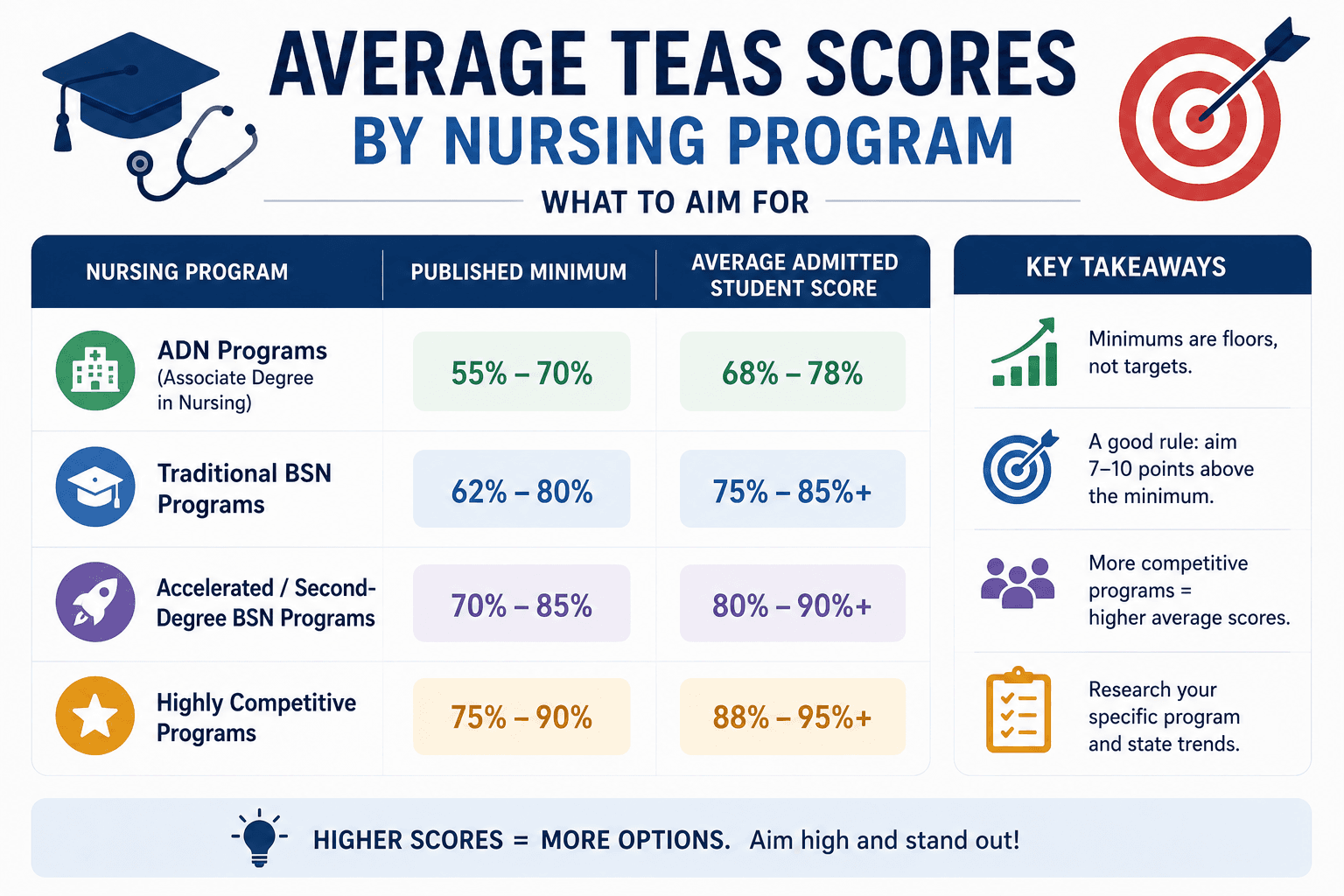
This is the case in nursing programs nationwide: The minimum scores are not what they actually receive when students apply for admission, and the difference is often significant, if not substantial. Programs that have a limited number of places available fill the programs with the highest-scoring applicants first — not just all those who met the cut-off. A basic rule of thumb that consistently emerges in admissions data: Take the published minimum points of a program and add about 7 to 10.
Average Score: By Program Type
Associate Degree in Nursing (ADN) programs are offered by 35 states and other jurisdictions. Community colleges and technical schools generally have published minimums between 55% and 70%. But for the most competitive programs, where there are more applicants than seats available, a score of 68-78 can be considered competitive, even though the lower limit is lower. While community college ADN programs are still the most accessible to enter the field, accessible minimum doesn't mean competitively average.
Traditional BSN programs Typically, between 62% and 80% are the minimums. Many public and private four-year colleges have an average of 75% to 85% for admitted students — and sometimes much higher. Consider the 80s and low 90s average for admitted students at flagship programs, despite the fact that their published minimums are 10-15 points lower.
Accelerated/second-degree BSN programs The most competitive tracks have published minimum 70% to 85% and means of admission are often at the high end of the range or above. Many of these programs require that the applicant already have a bachelor's degree and are very motivated to continue their education, making the effective competition even higher.
Highly competitive or prestigious programs. For instance, the top nursing schools have admitted-student averages in the high-80s and low 90s even with comparatively low published minimums of admitted students. But just a few of the more particular private colleges have admitted-class averages over 90% in recent years, which is a good reminder that a poor or average published minimum doesn't necessarily indicate how competitive the pool of applicants was.
The significance of State/Regional Variation
There are also meaningful differences in averages by state and regional competitiveness. State-level data from Texas, Pennsylvania, Ohio, Colorado and Florida, among others, indicate that BSN nursing programs with a high number of applicants compared to the number of programs tend to fall into the mid-to-high 70s and low-to-mid 80s range for BSN admission rates, while ADN programs are generally slightly lower but often exceed their published bottom line. When applying in a specific state, it's best to do some research on the ranges in that state, rather than just relying on national averages.
Typical issues that applicants encounter
Problem: "My score meets the published minimum, so I assumed I was competitive." Solution: If applicable, do some background research to determine the average of the admitted students rather than the floor, for the program in question (pages of the admission office or program fact sheets, or simply ask). Meeting minimum is not a competitive requirement.
Problem: I'm not sure what to set my realistic goal as. Solution: Add 7-10 points to the published minimums of your target program. This buffer is due to expected test-day fluctuation and is based on the recognition that most programs accept students at a level significantly higher than the floor.
You have many programs you are applying to that have different requirements. The problem is that you are applying for several programs, and they have different requirements. The solution: Take the range of your most discriminating program and use that as your overall target. If you do well enough on the high end of your list, you will have no problem getting your desired score in any of the other spots.
When writing a target program that doesn't publish a minimum, you get the following error message: Solution: There are some very selective schools that will rely on holistic review, meaning they don't have a published TEAS cutoff number, but consider your TEAS score along with other factors (GPA, essays, prerequisites, etc.). If so, review the most recent admitted class score profile (if available) and strive to match or exceed the higher end of the range of admitted score profile for similarly selective programs in your area.
"I'm not certain if I need to rely on national averages or my particular state. Solution: Always use national data as an approximation, but whenever possible, use your own data and/or program-specific data because regional competitiveness can move the actual target by a substantial amount.
How to Set Your Actual Target
- Determine the published minimum for your program, and set a 7-10 point working goal.
- If your program reports admitted-student average information, use this for your true benchmark point: Search for admitted-student average information (if your program reports it) and use that as your true benchmark point.
- Examine data on state or regional trends, as they have meaningfully different competitiveness.
- When applying to multiple schools with varying requirements, stick to the selective range of your most selective program.
- When information is published and is ambiguous or missing, confirm directly with admissions, don't assume that a low published minimum is a low bar in practice.
Final Thoughts
The minimum score for any nursing program is a beginning, not a finish line. The real competitiveness is the 7-12 or greater points that exist between that floor and what an admitted student actually scores, which is often the case at selective BSN and accelerated programs. Wherever possible, take data from those that have been admitted to the program and take the program-type patterns into account, and then set your target using those data, not the published minimum target.