Why Vocabulary is Important on the HESI Exam
Vocabulary questions usually test your ability to infer the meaning of words in isolation and in context, often drawing on general academic language and basic medical terminology. These skills will also help you on the reading comprehension section of the test. Unfamiliar words can slow you down or confuse your understanding of an entire passage.
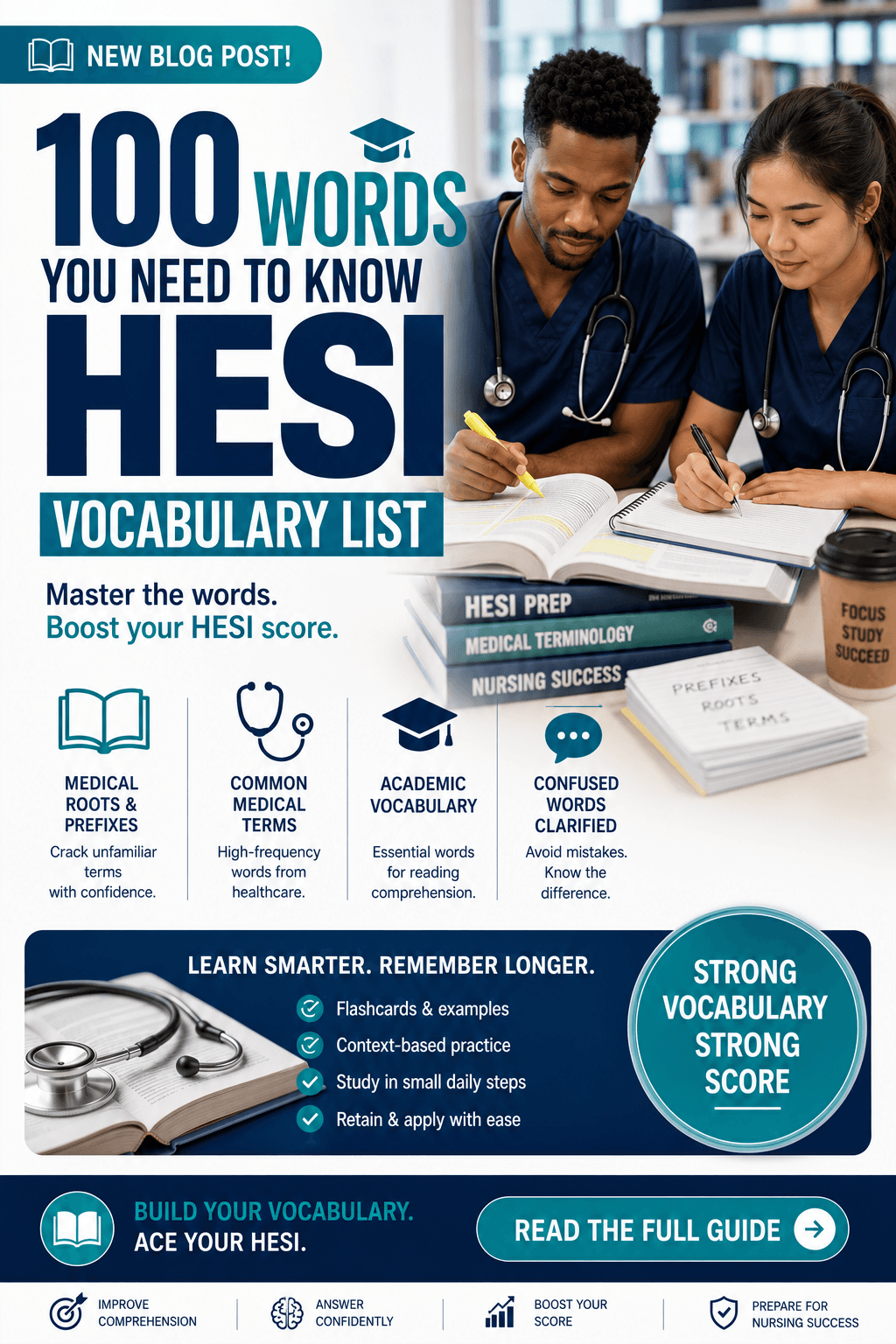
Medical Root Words and Prefixes (25 Terms)
In addition, even if you have not memorized a specific word before, knowing common medical prefixes and roots can help you figure out unfamiliar terms. Cardio- , Hepato- , Nephro- , Gastro- , Neuro- , Dermato- , Osteo- , Hemo- , Pulmo- , Cyto- , -itis , -ology , -ectomy , -otomy , -pathy , -algia , -emia , -uria , Brady- , Tachy- , Hyper- , Hypo- , Peri- , Sub- , Inter-
Medical Terms (25 Words) Common
These words are commonly seen in medical vocabulary sections and reading passages on healthcare topics.
Diagnosis Prognosis Chronic Acute Benign Malignant Contraindication Prescription Symptom Syndrome Pathogen Antibiotic Inflammation Infection Immunity Homeostasis Metabolism Ventilation Circulation Respiration Digestion Excretion Secretion Absorption Contraction
General Academic Vocabulary (25 Words)
In addition to medical terminology, the HESI vocabulary section also covers general academic and everyday words found in reading passages.
Ambiguous, Short, Resulting, Decrease, Ease, Wave, Assumption, Implied, Inevitable, Careful, Remark, Neutral, Plausible, Previous, Predominant, Common, Reason, Important, Following, Enough, Sensitive, Preliminary, Fundamental, Changeable, Confirm
Commonly Confused or Misused Words (25 Words)
They are easily confused with words that look or sound alike, so these are frequently tested words.
- Affect vs. Effect,
- Elicit vs. Illicit,
- Perspective vs. Prospective,
- Adverse vs. Averse,
- Complement vs. Compliment,
- Discreet vs. Discrete,
- Emigrate vs. Immigrate,
- Farther vs. Further,
- Principal vs. Principle,
- Stationary vs. Stationery
- Accept vs. Except,
- Advice vs. Advise,
- Allusion vs. Illusion,
- Assure, Ensure & Insure,
- Bias vs. Biased
- Continual vs. Continuous,
- Disinterested vs. Uninterested,
- Ensure vs. Insure,
- Precede vs. Proceed,
- Personal vs. Personnel,
- Than vs. Then,
- There, There & They're,
- Weather vs. Whether,
- Who's vs. Whose,
- Its vs. It's
How to Learn Vocabulary like a Pro
- Instead of memorizing an unbroken string of words group the words into categories as words that are related to each other are easier to remember as a group.
- Make your own flashcards with a short definition and a simple example sentence for each word.
- Learn about word roots and prefixes so you can work out very unfamiliar words when you sit the exam.
- Practice vocabulary using context-based questions, not just definitions, because the HESI exam often uses vocabulary in the context of a sentence or passage.
- Instead of trying to memorize the entire list in one study session, review words in small amounts each day.
Tips to Remember Difficult Words
- Associate new words with familiar ones. Link new vocabulary to words or ideas you already know.
- Use the words in your own sentences. This active use reinforces the meaning better than passive memorization.
- Group similar sounding words and compare them side by side to clarify subtle differences.
- Test yourself regularly, but do not just read your list repeatedly – try flashcards or practice questions instead.
In conclusion
There is not one vocabulary list that will cover every word that you will see on the HESI, but if you focus your study on high frequency medical terms, general academic vocabulary and frequently confused pairs of words, you will build a solid, focused base. Rather than attempting to memorize an overwhelming number of random words, use this organized list as a starting point, and review it consistently in small, manageable sections. A strong vocabulary will not only help you with this one section, but it will also help you with the rest of the exam and your nursing education in general.