Myth 1: There is only one passing score
Many students think that there is a one-size-fits-all passing score for all nursing programs everyplace. The truth is, every nursing program has their own minimum passing score for the HESI A2 and Exit Exam sections, which is why students of different schools may have very different requirements even when taking the same exam. As always, check with your particular program’s requirements, not a general number you might see referenced online.
Myth 2: The Personality and Learning Style Sections Are Not Flat
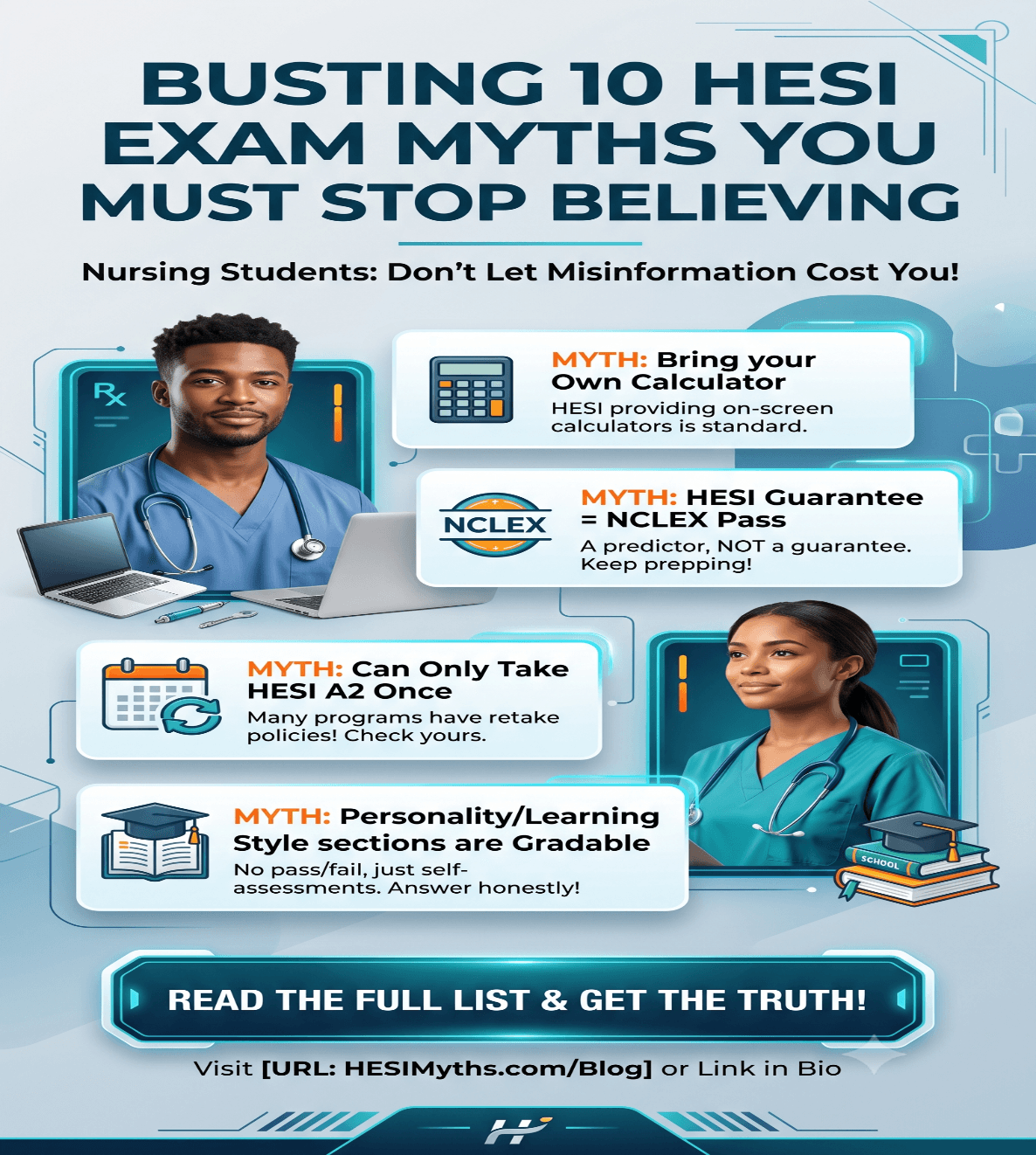
Some students waste valuable time trying to figure out how to answer strategically the personality profile or learning style assessment sections. Most of these sections are self-assessments and are not graded on a pass/fail basis, so there is no “right” way to answer to help your chances of admission. It is easier and more accurate to answer honestly than to try to guess what answer is preferred.
Myth 3: If you pass the HESI Exit Exam, you can count on passing the NCLEX
A good HESI Exit Exam score is a very good predictor of NCLEX readiness, but it is a predictor, not a guaranty. The Exit Exam, however, is only part of the picture. Exam format differences — particularly the NCLEX’s computerized adaptive testing structure — and the time between the two exams means that continued preparation is still important, even after a strong Exit Exam score.
Myth 4: You can only take the HESI A2 once
Many students believe that one low score means they are out of a nursing program for life. In reality, most programs have a formal retesting policy that permits students to retake the exam after a specified waiting period. Different institutions have different specific limits on attempts and waiting periods, so it is worth checking your program’s specific policy, rather than assuming one attempt only.
Myth 5: You Need a Calculator for the Math Portion
Some students worry about bringing their own calculator, or feel unprepared if they do not have one. As a rule, the HESI exam provides a calculator on the screen for the math sections, so you do not need to bring your own calculator. Check your specific testing center’s policy in advance, but do not assume that you will have to bring your own device.
Myth 6: All Nursing Programs Require the Same HESI Sections
A common misconception is that the HESI A2 has the same set of sections at all times for all students. In reality, this varies by individual nursing program. Each program customizes what sections they require, so your particular exam experience may look very different from a classmate applying to a different school. Check with your program for the exact requirements. Do not assume what you see here is universal.
Myth 7: You do not have the Right 20 to become a Nurse
It is one of the more damaging myths, emotionally, and simply not true. An exam grade is a snapshot of how you did on that one particular test at that one particular time, not a measure of your overall potential or ability as a future nurse. Many successful nurses did not pass every HESI section on their first try. Programs include remediation and retake options because this result is common and recoverable.
Myth 8: You Should Treat Every Subject the Same
Some students think that being well prepared means spending equal time on all possible content areas regardless of their own strengths and weaknesses. In practice, focused studying based on a diagnostic practice test is usually much more effective than spreading your study time evenly among subjects you may already know well. Treating all subjects as equally questionable does not produce as good results as focusing on real weak points.
Myth 9: The HESI Exam Tests Nursing-Specific Clinical Knowledge from the Beginning
Specifically with the HESI A2, some students mistakenly think they need to have nursing-specific clinical knowledge before they even start their program. In fact, it is more of a general academic readiness test for math, reading, vocabulary, grammar and foundational science rather than knowledge of nursing practice that is more heavily emphasized later on the Exit Exam.
Myth 10: Cramming Is Okay
Many students think that a last-minute cram session the night before the exam will make a big difference in their score. In fact, regular practice over time is generally more effective than last minute cramming, and getting a good night’s sleep the night before your exam is often more beneficial to your focus and performance than sacrificing sleep to review more at the last minute.
The Persistence of These Myths
Misinformation about standardized exams like the HESI is often passed along thru informal sources – classmates repeating secondhand information, outdated online forum posts, or simple assumptions that seem reasonable but are not actually true. HESI policies and requirements vary so much from school to school that these general claims that you find online are not always applicable to your particular situation. It is especially important to check with your own nursing program when you can.
How to Not Fall for Exam Myths
- Check requirements directly with your nursing program and do not rely on generalizations made on online forums or second-hand information from classmates.
- Consult your official HESI or program-provided materials for the most accurate information about scoring, format, and policies as they pertain to your exam version.
- Question absolute claims, especially anything that implies one universal rule applies to every student or every program.
- If you are ever in doubt about something you have heard about the HESI exam, ask your academic advisor directly.
Last Thoughts
HESI exam myths can cause unnecessary stress, misdirected study effort, and unrealistic expectations that do not really reflect how the exam and surrounding policies actually work. Instead of listening to hearsay, confirm facts with your particular nursing program and go into your HESI preparation with realistic expectations and your energy on what really matters – good, targeted preparation, not misplaced worry over misconceptions that don’t hold up to scrutiny.